


Page 26 - Curriculum Visions Dynamic Book. To close the book, close the tab.
P. 26
26
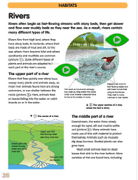
Rivers flow from high land, where they have stony beds, to lowlands, where their beds are made of mud and silt, to the sea, where rivers become tidal and where sandbanks and mudflats are common (picture ). Quite different types of plants and animals are adapted to live in each part of the river’s course.
The upper part of a river
Rivers that flow quickly over stony beds sweep many plants and animals away, so most river animals found here are strong swimmers, or can shelter between the rocks (picture ). Here, animals feed
on leaves falling into the water, or catch insects on or in the water.
Fish such as trout swim strongly but, even so, they prefer the pools, while most smaller creatures have to live in the shelter of rocks.
Dippers can swim in fast-flowing water and eat insect larvae that cling to the stones. They nest in rocky crevices in river banks.
Middle part with slower flowing water and sandy river bed
The course of a river.
Upper part with fast-flowing water and stony river bed
Tidal part with sandbanks
The upper reaches of a river, where the bed is stony.
The middle part of a river
Downstream, the water flows slowly enough for sand, silt and mud to settle out (picture ). Many animals have made use of this soft material to protect themselves. Animals such as mussels dig deep burrows. Rooted plants can also grow here.
Most small animals feed on dead leaves that sink to the river bottom. More varieties of fish are found here, including
HABITATS
Rivers
Rivers often begin as fast-flowing streams with stony beds, then get slower and flow over muddy beds as they near the sea. As a result, rivers contain many different types of life.


