


Page 25 - Curriculum Visions Dynamic Book. To close the book, close the tab.
P. 25
This means that pond life does not have to adapt so much to the weather in order to survive (picture ).
Plants in a pond
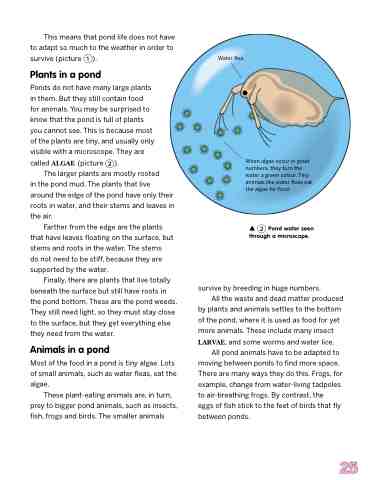
Ponds do not have many large plants in them. But they still contain food for animals. You may be surprised to know that the pond is full of plants you cannot see. This is because most of the plants are tiny, and usually only visible with a microscope. They are called algae (picture ).
The larger plants are mostly rooted
in the pond mud. The plants that live around the edge of the pond have only their roots in water, and their stems and leaves in the air.
Farther from the edge are the plants that have leaves floating on the surface, but stems and roots in the water. The stems
do not need to be stiff, because they are supported by the water.
Finally, there are plants that live totally beneath the surface but still have roots in the pond bottom. These are the pond weeds. They still need light, so they must stay close to the surface, but they get everything else they need from the water.
Animals in a pond
Most of the food in a pond is tiny algae. Lots of small animals, such as water fleas, eat the algae.
These plant-eating animals are, in turn, prey to bigger pond animals, such as insects, fish, frogs and birds. The smaller animals
Water flea
When algae occur in great numbers, they turn the water a green colour. Tiny animals like water fleas eat the algae for food.
Pond water seen through a microscope.
survive by breeding in huge numbers.
All the waste and dead matter produced
by plants and animals settles to the bottom of the pond, where it is used as food for yet more animals. These include many insect larvae, and some worms and water lice.
All pond animals have to be adapted to moving between ponds to find more space. There are many ways they do this. Frogs, for example, change from water-living tadpoles to air-breathing frogs. By contrast, the
eggs of fish stick to the feet of birds that fly between ponds.
25


