


Page 168 - Curriculum Visions Dynamic Book
P. 168
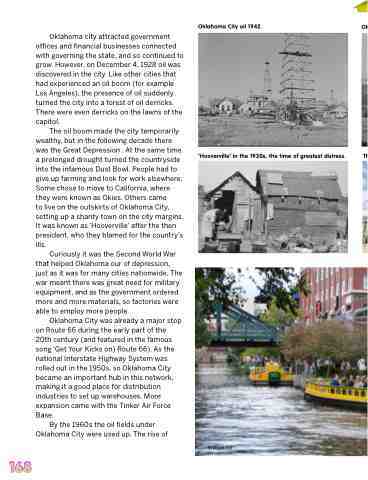
Oklahoma city attracted government offices and financial businesses connected with governing the state, and so continued to grow. However, on December 4, 1928 oil was discovered in the city. Like other cities that had experienced an oil boom (for example Los Angeles), the presence of oil suddenly turned the city into a forest of oil derricks. There were even derricks on the lawns of the capitol.
The oil boom made the city temporarily wealthy, but in the following decade there was the Great Depression . At the same time a prolonged drought turned the countryside into the infamous Dust Bowl. People had to give up farming and look for work elsewhere. Some chose to move to California, where they were known as Okies. Others came
to live on the outskirts of Oklahoma City, setting up a shanty town on the city margins. It was known as ‘Hooverville’ after the then president, who they blamed for the country’s ills.
Curiously it was the Second World War that helped Oklahoma our of depression, just as it was for many cities nationwide. The war meant there was great need for military equipment, and as the government ordered more and more materials, so factories were able to employ more people.
Oklahoma City was already a major stop on Route 66 during the early part of the 20th century (and featured in the famous song ‘Get Your Kicks on) Route 66). As the national Interstate Highway System was rolled out in the 1950s, so Oklahoma City became an important hub in this network, making it a good place for distribution industries to set up warehouses. More expansion came with the Tinker Air Force Base.
By the 1960s the oil fields under Oklahoma City were used up. The rise of
‘Hooverville’ in the 1930s, the time of greatest distress. T
Oklahoma City oil 1942. O
168
Wikipedia
k
h


