


Page 169 - Curriculum Visions Dynamic Book
P. 169
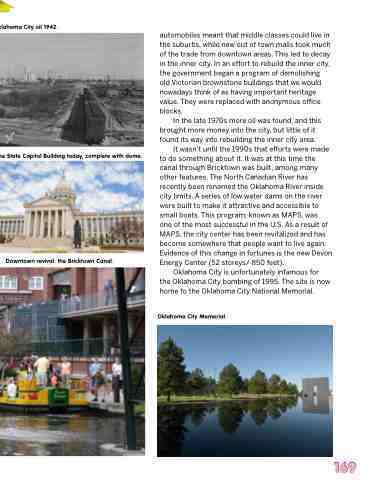
lahoma City oil 1942.
e State Capitol Building today, complete with dome.
automobiles meant that middle classes could live in the suburbs, while new out of town malls took much of the trade from downtown areas. This led to decay in the inner city. In an effort to rebuild the inner city, the government began a program of demolishing old Victorian brownstone buildings that we would nowadays think of as having important heritage value. They were replaced with anonymous office blocks.
In the late 1970s more oil was found, and this brought more money into the city, but little of it found its way into rebuilding the inner city area.
It wasn’t until the 1990s that efforts were made to do something about it. It was at this time the canal through Bricktown was built, among many other features. The North Canadian River has recently been renamed the Oklahoma River inside city limits. A series of low water dams on the river were built to make it attractive and accessible to small boats. This program, known as MAPS, was
one of the most successful in the U.S. As a result of MAPS, the city center has been revitalized and has become somewhere that people want to live again. Evidence of this change in fortunes is the new Devon Energy Center (52 storeys/ 850 feet).
Oklahoma City is unfortunately infamous for the Oklahoma City bombing of 1995. The site is now home to the Oklahoma City National Memorial.
Oklahoma City Memorial.
Downtown revival: the Bricktown Canal.
169
k
h


