


Page 192 - Curriculum Visions Dynamic Book
P. 192
192
By 1816, there were 250 homes in the town. Railroad transportation served as a significant cause of population expansion in Columbia during this time. Rail lines reached the city in the 1840s, but these were freight, not passenger lines, and were used to carry cotton bales. In 1850 all of the city’s business was related to cotton. In the 1850s and 1860s Columbia was the largest inland city in the Carolinas.
In 1830, 1,500 slaves lived and worked in Columbia. By 1860 it had reached 3,300.
But differences between the abolitionist north, and the pro-slavery south were coming to a head. The South Carolina Secession Convention met in Columbia in 1860. Columbia was ideally placed for other meetings within the Confederacy.
It was this heritage that made the city
a target for Union troops in 1865. Much of Columbia was destroyed by fire while being occupied by Union troops under the command of General Sherman.
As a result of this, much of historic Columbia was destroyed, and the majority of the city had to be rebuilt. After that it was a matter of rebuilding factories and getting jobs back again. It was all painfully slow. But by the early 20th century Columbia had become a textile manufacturing center. In 1907 the mills employed over 3,400. But still Columbia had no paved streets until 1908,
It was only during the Second World War and after that Columbia started tog row quickly and reached over a quarter of a million by the end of the 1950s.
In recent years there have been attempts to make the most of the surviving historic buildings such as the Robert Mills House.
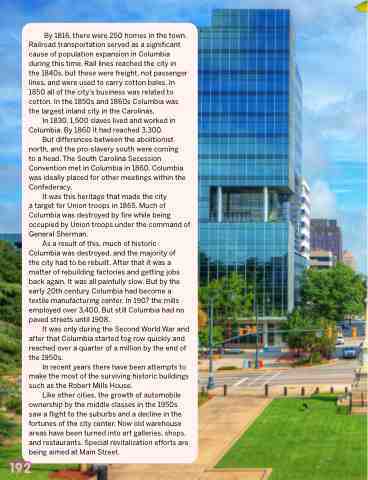
Like other cities, the growth of automobile ownership by the middle classes in the 1950s saw a flight to the suburbs and a decline in the fortunes of the city center. Now old warehouse areas have been turned into art galleries, shops, and restaurants. Special revitalization efforts are being aimed at Main Street.


