


Page 184 - Curriculum Visions Dynamic Book
P. 184
They sought refuge with the Narragansett tribe at a place on the banks of a salt cove, as the chief of the Narragansett, Canonicus, made them welcome. In 1636, Canonicus gave Williams the large tract of land which was the beginning of the colony of Providence Plantation. It soon developed industries such as distilling using sugar imported through the port.
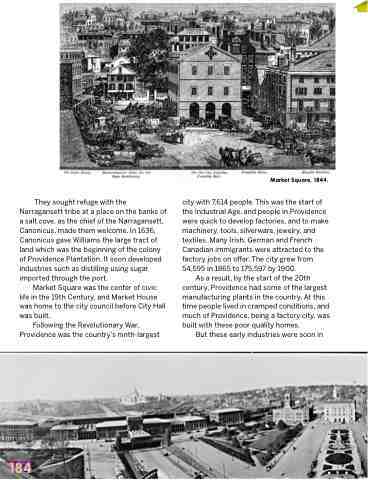
Market Square was the center of civic life in the 19th Century, and Market House was home to the city council before City Hall was built.
Following the Revolutionary War, Providence was the country’s ninth-largest
Market Square, 1844.
city with 7,614 people. This was the start of the Industrial Age, and people in Providence were quick to develop factories, and to make machinery, tools, silverware, jewelry, and textiles. Many Irish, German and French Canadian immigrants were attracted to the factory jobs on offer. The city grew from 54,595 in 1865 to 175,597 by 1900.
As a result, by the start of the 20th century, Providence had some of the largest manufacturing plants in the country. At this time people lived in cramped conditions, and much of Providence, being a factory city, was built with these poor quality homes.
But these early industries were soon in
184


