


Page 146 - Curriculum Visions Dynamic Book
P. 146
146
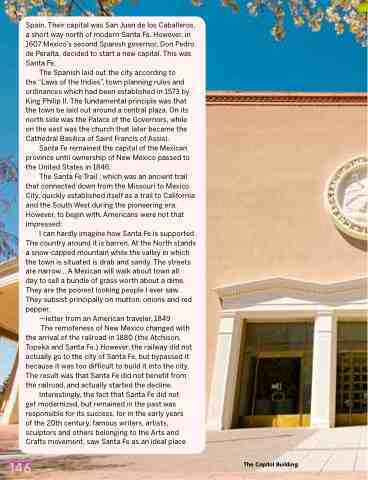
The Capitol Building.
Spain. Their capital was San Juan de los Caballeros, a short way north of modern Santa Fe. However, in 1607 Mexico’s second Spanish governor, Don Pedro de Peralta, decided to start a new capital. This was Santa Fe.
The Spanish laid out the city according to
the “Laws of the Indies”, town planning rules and ordinances which had been established in 1573 by King Philip II. The fundamental principle was that the town be laid out around a central plaza. On its north side was the Palace of the Governors, while on the east was the church that later became the Cathedral Basilica of Saint Francis of Assisi.
Santa Fe remained the capital of the Mexican province until ownership of New Mexico passed to the United States in 1846.
The Santa Fe Trail , which was an ancient trail that connected down from the Missouri to Mexico City, quickly established itself as a trail to California and the South West during the pioneering era. However, to begin with, Americans were not that impressed:
I can hardly imagine how Santa Fe is supported. The country around it is barren. At the North stands a snow-capped mountain while the valley in which the town is situated is drab and sandy. The streets are narrow... A Mexican will walk about town all
day to sell a bundle of grass worth about a dime. They are the poorest looking people I ever saw. They subsist principally on mutton, onions and red pepper.
—letter from an American traveler, 1849
The remoteness of New Mexico changed with
the arrival of the railroad in 1880 (the Atchison, Topeka and Santa Fe.) However, the railway did not actually go to the city of Santa Fe, but bypassed it because it was too difficult to build it into the city. The result was that Santa Fe did not benefit from the railroad, and actually started the decline.
Interestingly, the fact that Santa Fe did not get modernized, but remained in the past was responsible for its success, for in the early years of the 20th century, famous writers, artists, sculptors and others belonging to the Arts and Crafts movement, saw Santa Fe as an ideal place


