


Page 8 - Curriculum Visions Dynamic Book. To close the book, close the tab.
P. 8
8
LIVING THINGS
Changes through their lives
During their lives, all living things go through stages as they grow up, get older and die. At each stage they have to be adapted to the environment around them.
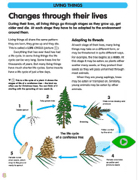
Living things all share the same pattern: they are born, they grow up and they die. This is called a life cycle (picture ).
Everything that has ever lived has had a life cycle. In some living things the life cycle can be very long. Some trees live for thousands of years. But many living things have much shorter life cycles. Some insects have a life cycle of just a few days.
This is a life cycle of a plant. It shows the stages of life of a coniferous tree – the kind we often use for Christmas trees. You can think of it starting with the sprouting of new seeds (1).
2
Fully grown tree
Adapting to threats
At each stage of their lives, many living things may take on a different form, or may be threatened in quite different ways. For example, the tree begins as a seed. At this stage it may be eaten, so plants either scatter many seeds, or they protect their seeds so they will pass unharmed through most animals.
When they are young saplings, trees may be eaten or trampled on. Similarly, young animals may be eaten by other animals.
1
Seeds sprout
3
Male cones develop and produce .
Pollen carried by the wind.
4
Female cones take up pollen and produce seeds.
5
Female cones shed seeds, which drop to the ground ready to sprout.
The life cycle
of a coniferous tree
Breeding


