


Page 10 - Curriculum Visions Dynamic Book. To close the book, close the tab.
P. 10
LIVING THINGS
How plants adapt and survive
If a plant is to get through its life cycle, it has to have ways of staying alive and getting its seeds to thrive.
All living things survive over time only if they can stay alive long enough to produce at least one offspring to replace each adult.
This is not as easy as it sounds. Many things can prevent a plant from producing seeds, or destroy the seeds.
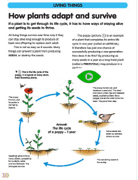
This is the life cycle of the poppy. It is typical of many short- lived flowering plants.
The poppy flowers, and its pollen is carried by insects.
The poppy (picture ) is an example of a plant that completes its entire life cycle in one year (called an annual).
It therefore has just one chance of successfully producing a new generation. How does it do this? By producing as many seeds in a year as a long-lived plant (called a perennial) may produce in a century.
The poppy is fertilised and develops a seed pod. The seed pod opens when ripe and releases seeds, scattering them like a pepper pot as the wind rocks the stem. The plant then dies.
Annual:
The life cycle
of a poppy – 1 year
Some seeds are eaten by animals; others survive.
The remaining seeds in the spring.
Seedlings grow among many others, competing for sunlight, water
and nourishment. The strongest survive.
10


