


Page 18 - Curriculum Visions Dynamic Book. To close the book, close the tab.
P. 18
HABITATS
A tree as a home
Every living thing has to find a place where it can live, find food and protect itself from others. Here is what happens in an oak tree.
Just like us, animals and plants have a place where they live – a kind of home. We call this natural home a habitat.
A fully-grown oak tree may be 30 to 35 metres tall and spread its branches nearly as wide (picture ). Its many leaves allow it to soak up the light that it needs to make its own food, and it gets water and other nourishment from the ground. The oak tree survives where it does because it is adapted to cope with a cold winter (see page 20).
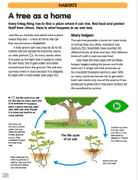
The life cycle of an oak. An oak lives for many years and is an example of a perennial plant. It grows and sets seed year after year even though
it is home and food for so many animals.
Oak trees use
the wind to share pollen, but use birds and animals to help disperse acorns. After hundreds of years the tree finally dies.
Many seedlings are eaten by animals or insects. The ones that survive grow slowly into mature trees.
Many lodgers
The oak tree provides a home for more kinds of animal than any other woodland tree (picture ). Scientists have counted 30 different kinds of birds and over 200 different kinds of moth in just one oak tree!
How does the tree cope with all these hungry lodgers eating its leaves and fruits (acorns)? A single oak tree produces up
to a hundred thousand acorns a year. With
so many, some are bound not to get eaten. Each oak needs only one of the acorns it has produced to grow into a tree each century for the woodland to survive.
The life cycle of an oak
Acorns drop from the tree. Most
are eaten, or are destroyed by disease or insects, but a few survive.
Acorns grow up into new trees.
18


