


Page 17 - Curriculum Visions Dynamic Book. To close the book, close the tab.
P. 17
Checks and balances
There must be a way for plants and animals to survive. Nature’s way is to make sure that no one kind of living thing is entirely wiped out by another.
You can understand how this works by imagining a forest edge where there are grasses, rabbits and foxes (picture ). Rabbits are plant eaters, and foxes are meat eaters.
In a good year the grass
may grow strongly and so there
is plenty of food for the rabbits. So, the rabbits breed well. Now there is more
food for the foxes, so they breed
well, too. But if there are too many
rabbits and they eat all of the grass,
the grass will not grow up and many rabbits will starve. With fewer rabbits to eat, the fox numbers will also go down. Now there is a chance for the grass to grow up again.
Food chain
As you can see, in nature there is
a long line of animals, each depending on another animal or a plant for its
food. Scientists call this a food chain.
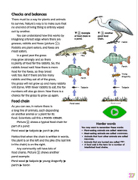
Picture shows a typical food chain for part of a pond:
Pond weed tadpole perch pike
Example of food chain in a pond.
Another pond food chain.
Notice that when the chain is written in words, the plant is on the left and the pike (the last link in the chain) is on the right.
Any community will have lots of food chains. Picture shows another pond example:
Pond weed tadpole young dragonfly perch heron
You may want to remember these words:
• Plant-eating animals are called herbivores. • Meat-eating animals are called carnivores. • Animals that hunt other animals are called
predators.
• Animals that are hunted are called prey. • A food web is the term for a number of
interlinked food chains.
Pond weed
Pond weed
Harder words
Pike
Perch
Tadpole
Heron
Perch
Young dragonfly
Tadpole
17


