


Page 84 - Curriculum Visions Dynamic Book
P. 84
been part of French, British, and Spanish colonies.
For 10,000 years before French explorer Sieur d’Iberville led an exploration party up the Mississippi River in 1699, this had been home to a number of Native American peoples, many of them mound builders. When the French arrived, it was the hunting grounds of
the Houma and Bayou Goula tribes. The French expedition named their newly established settlement Baton Rouge, after the red post that was put up to mark the boundary between the hunting grounds of the tribes.
The first true settlement was a military post built in 1719 by French colonists. It was a small remote settlement until in 1755 the French were pushed out of Acadia (Maine) by the British. While some went to Canada, others came down to Louisiana and to Baton Rouge. The Acadians, became known by a corrupted form of the word and were called Cajuns. Nevertheless,
it was only in the 19th century, and the development of the steamboat trade and migration to the Prairies and beyond, that Baton Rouge started to grow. It was ideally placed to help get goods up the
Mississippi to staging posts like Saint Louis and so supply the pioneers with the goods they needed for the westward Oregon Trail.
Baton Rouge became Louisiana’s state capital in 1849. The Capitol building was designed like a Neo-Gothic medieval castle, with touches of cathedral thrown in. It has turrets, crenellations, and stained glass.
By the outbreak of the Civil War, the population of Baton Rouge was nearly 5,500.
However, after the war, New Orleans was at first used as the seat of government, returning the state government to Baton Rouge in 1882. By 1893 it was described
in a travel guide as ‘a quaint old place with 10,378 inhabitants, on a bluff above the Mississippi.’
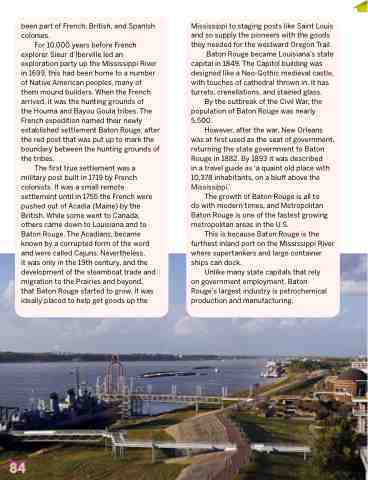
The growth of Baton Rouge is all to do with modern times, and Metropolitan Baton Rouge is one of the fastest growing metropolitan areas in the U.S.
This is because Baton Rouge is the
Unlike many state capitals that rely on government employment, Baton Rouge’s largest industry is petrochemical production and manufacturing.
furthest inland port on the Mississippi River where supertankers and large container ships can dock.
Baton Rouge today.
84


