


Page 72 - Curriculum Visions Dynamic Book
P. 72
72
Like many other cities on the prairie, it was impossible to get farm products to markets, and so the area grew only very slowly until the arrival of the railroad in 1866 changed things completely.
Just before this, in 1864, a coal mining company had been founded to make use of the coal under the surface. By the 1880s the city and its surroundings were dotted with mine shafts. For half a century coal mining was an important way of making a living, but by the early 1900s the coal was exhausted.
A combination of coal mining and trading with the surrounding farmers made Des Moines the biggest city in Iowa by 1880, although it still had a modest twenty two thousand people.
At the turn of the 20th century, Des Moines built many of what are now its main historic buildings (now the Civic Center Historic District), including the City Hall.
The mining of coal had allowed many other manufacturing industries to grow, but over the years these industries too began to fade away, as the location of Des Moines made them less competitive than elsewhere. As a result, the city began to decline, something it shared with many other manufacturing cities.
With the arrival of cheap automobiles, many better off families moved from the central part of Des Moines into the suburbs, making the city’s decline even more severe.
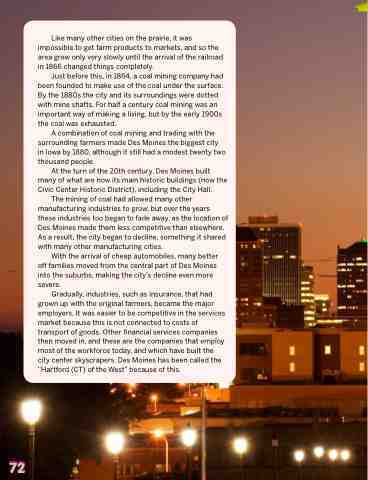
Gradually, industries, such as insurance, that had grown up with the original farmers, became the major employers. It was easier to be competitive in the services market because this is not connected to costs of transport of goods. Other financial services companies then moved in, and these are the companies that employ most of the workforce today, and which have built the city center skyscrapers. Des Moines has been called the “Hartford (CT) of the West” because of this.


