


Page 71 - Curriculum Visions Dynamic Book
P. 71
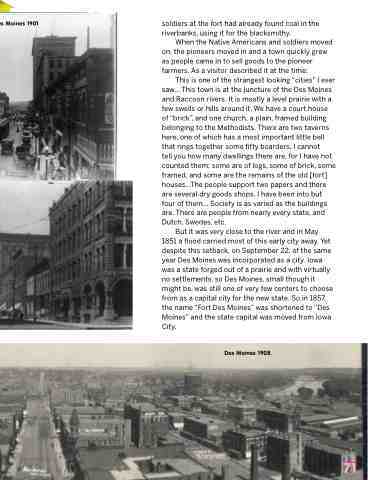
s Moines 1901
soldiers at the fort had already found coal in the riverbanks, using it for the blacksmithy.
When the Native Americans and soldiers moved on, the pioneers moved in and a town quickly grew as people came in to sell goods to the pioneer farmers. As a visitor described it at the time:
This is one of the strangest looking “cities” I ever saw... This town is at the juncture of the Des Moines and Raccoon rivers. It is mostly a level prairie with a few swells or hills around it. We have a court house of “brick”, and one church, a plain, framed building belonging to the Methodists. There are two taverns here, one of which has a most important little bell that rings together some fifty boarders. I cannot
tell you how many dwellings there are, for I have not counted them; some are of logs, some of brick, some framed, and some are the remains of the old [fort] houses...The people support two papers and there are several dry goods shops. I have been into but four of them... Society is as varied as the buildings are. There are people from nearly every state, and Dutch, Swedes, etc.
But it was very close to the river and in May 1851 a flood carried most of this early city away. Yet despite this setback, on September 22, of the same year Des Moines was incorporated as a city. Iowa was a state forged out of a prairie and with virtually no settlements, so Des Moines, small though it might be, was still one of very few centers to choose from as a capital city for the new state. So in 1857, the name “Fort Des Moines” was shortened to “Des Moines” and the state capital was moved from Iowa City.
Des Moines 1908.
71
e


