


Page 66 - Curriculum Visions Dynamic Book
P. 66
66
It was the threat of continued Native American raids up to this point that helped to decide the location of the second capital. That is why a town in the far southern part of Indiana, Corydon, was named the second capital of the Indiana Territory in May 1813. In 1825, the state capital was moved from Corydon to Indianapolis.
In their push west, the new American government were anxious to attract people west, to the Ohio Valley and beyond. In an effort to speed this up, they began
to offer parcels of land. In this tall grass and woodland region, the first European Americans to permanently settle in the area that became Indianapolis were the family of John McCormick. They built a cabin along the White River in February 1820 at the mouth of Fall Creek. It was in the middle of the state and became the county seat of Marion County in 1821.
In, 1820, the Indiana General Assembly authorized a committee of ten commissioners to select a
site in central Indiana for a new state capital. The commissioners used the Indianapolis site on the White River because they (incorrectly) assumed that it would be good for transportation. Remember, the railroad
had not been invented at this time, so waterways were vital. Most goods were moved by shallow flat-bottomed keelboats, or on overland wagons. Indianapolis became the state capital of Indiana in 1825. Jeremiah Sullivan, a judge of the Indiana Supreme Court, invented the name Indianapolis by joining Indiana with polis, the Greek word for city; Indianapolis literally means “Indiana City”.
When the city was designated as the capital, it
was just a small, roughly-built collection of houses and businesses. It was decided that this would not do for the capital city and so Alexander Ralston and Elias Pym Fordham were set to design a city plan. At its core was the Governor’s Circle (now Monument Circle because of its 284ft/87m limestone and bronze Soldiers’ and Sailors’ Monument), a large circular area of lawn at the center of the city. A brick governor’s mansion was built in the circle in 1827. No governor ever lived there, and it was demolished in 1857. Radiating from the Governor’s Circle were four diagonal streets named avenues. The normal grid of roads enclosed this circle.
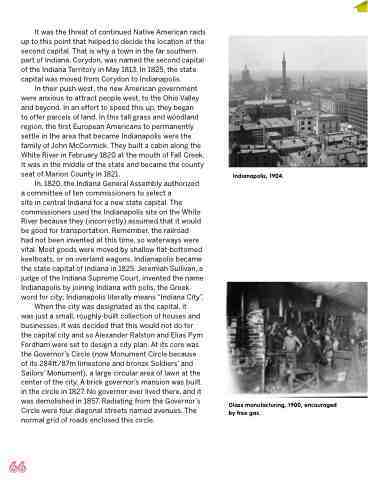
Indianapolis, 1904.
Glass manufacturing, 1900, encouraged by free gas.


