


Page 42 - Curriculum Visions Dynamic Book
P. 42
Delaware
Dover, the capital city of Delaware
Elevation 36 ft (11 m) Population 36,047 Metro 152,255 Founded 1683 Incorporated 1717
Dover is the capital and second largest city in Delaware. It is on the banks of the St. Jones River and part
of the Delaware River coastal plain. It was named by
William Penn for Dover in Kent, England.
Dover was founded as the court town for newly
established Kent County in 1683 by William Penn, who was the owner (called the proprietor) of the territory called the “Lower Counties on the Delaware.”
In 1717, Dover city plan was laid out, including
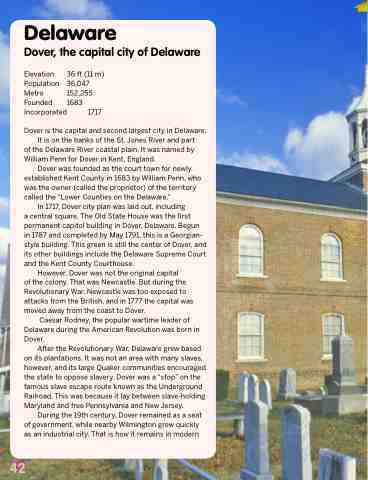
a central square. The Old State House was the first permanent capitol building in Dover, Delaware. Begun in 1787 and completed by May 1791, this is a Georgian- style building. This green is still the center of Dover, and its other buildings include the Delaware Supreme Court and the Kent County Courthouse.
However, Dover was not the original capital
of the colony. That was Newcastle. But during the Revolutionary War, Newcastle was too exposed to attacks from the British, and in 1777 the capital was moved away from the coast to Dover.
Caesar Rodney, the popular wartime leader of Delaware during the American Revolution was born in Dover.
After the Revolutionary War, Delaware grew based on its plantations. It was not an area with many slaves, however, and its large Quaker communities encouraged the state to oppose slavery. Dover was a “stop” on the famous slave escape route known as the Underground Railroad. This was because it lay between slave-holding Maryland and free Pennsylvania and New Jersey.
During the 19th century, Dover remained as a seat of government, while nearby Wilmington grew quickly as an industrial city. That is how it remains in modern
42


