


Page 208 - Curriculum Visions Dynamic Book
P. 208
Immigrants also started to arrive for the first time. Gradually the city was transformed from a frontier town to a bustling modern with gas street lamps in 1874 and streetcars in 1875.
In 1881 a fire destroyed the wooden capitol building, so in 1875 a new Texas State Capitol was begun. This is the building we see today. The building is 15 feet (4.6 m) taller than the Capitol in Washington, D.C.
In 1876 Texas set out to build a world class university, and that was founded in Austin. It was, however, difficult to attract manufacturing to what was still a remote part of the country. Oil was never found near Austin and so it did not benefit from the boom affecting other Texas cities.
Other changes, however, were underway. By the 1940s a considerable proportion of the city population was already Mexican- American
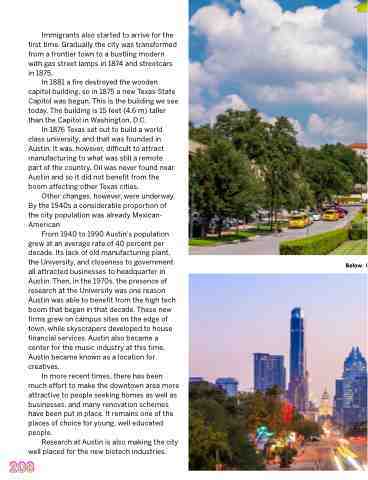
From 1940 to 1990 Austin’s population grew at an average rate of 40 percent per decade. Its lack of old manufacturing plant, the University, and closeness to government all attracted businesses to headquarter in Austin. Then, in the 1970s, the presence of research at the University was one reason Austin was able to benefit from the high tech boom that began in that decade. These new firms grew on campus sites on the edge of town, while skyscrapers developed to house financial services. Austin also became a center for the music industry at this time. Austin became known as a location for creatives.
In more recent times, there has been much effort to make the downtown area more attractive to people seeking homes as well as businesses, and many renovation schemes have been put in place. It remains one of the places of choice for young, well educated people.
Research at Austin is also making the city well placed for the new biotech industries.
Below:
208
C


