


Page 203 - Curriculum Visions Dynamic Book
P. 203
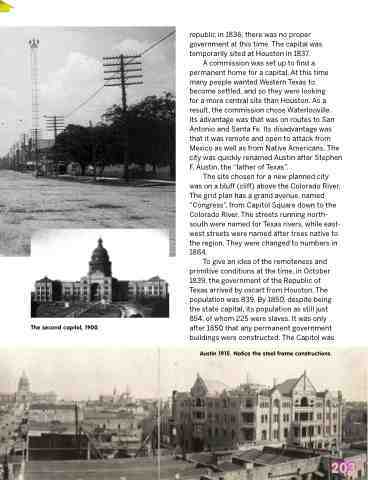
The second capitol, 1900.
republic in 1836, there was no proper government at this time. The capital was temporarily sited at Houston in 1837.
A commission was set up to find a permanent home for a capital. At this time many people wanted Western Texas to become settled, and so they were looking
for a more central site than Houston. As a result, the commission chose Waterlooville.
Its advantage was that was on routes to San Antonio and Santa Fe. Its disadvantage was that it was remote and open to attack from Mexico as well as from Native Americans. The city was quickly renamed Austin after Stephen F. Austin, the “father of Texas”.
The site chosen for a new planned city was on a bluff (cliff) above the Colorado River. The grid plan has a grand avenue, named “Congress”, from Capitol Square down to the Colorado River. The streets running north- south were named for Texas rivers, while east- west streets were named after trees native to the region. They were changed to numbers in 1884.
To give an idea of the remoteness and primitive conditions at the time, in October 1839, the government of the Republic of Texas arrived by oxcart from Houston. The population was 839. By 1850, despite being the state capital, its population as still just 854, of whom 225 were slaves. It was only after 1850 that any permanent government buildings were constructed. The Capitol was
Austin 1915. Notice the steel frame constructions.
203


