


Page 200 - Curriculum Visions Dynamic Book
P. 200
The location of Nashville was The Natchez Trace, a historical path that extends roughly 440 miles
(710 km) from Natchez, Mississippi, to Nashville, Tennessee, linking the Cumberland, Tennessee,
and Mississippi Rivers. It was created by Native Americans, and was later used by early European and American explorers, traders, and emigrants in the late 18th and early 19th centuries.
As the northern terminus of the Natchez Trace, Nashville quickly developed as a cotton center and river port and later as a railroad hub. Nevertheless, in this frontier area, successful did not mean large. By 1800, the city had just 345 residents, including 136 African American slaves and 14 free blacks.
in 1796, North Carolina ceded its land from the Allegheny Mountains to the Mississippi River to the federal government which reformed it as the state of Tennessee. Nashville was still a tiny settlement in a vast forest and grassland area. But nevertheless it became the state capitol because of its central location.
Andrew Jackson was a lawyer in growing Nashville when, as General Jackson, using the Tennessee militia as a core of his fighting force, he defeated the Creek Indians at the Battle of Horseshoe Bend and the British invasion army at the Battle of New Orleans. This turned him into a national hero. By 1828, Jackson was elected President.
The Tennessee State Capitol – in Greek revival style – took from 1845 to 1859 to build.
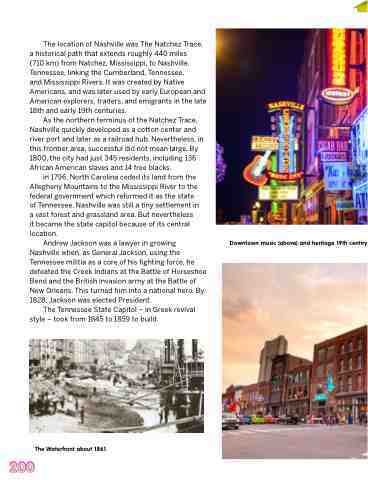
The Waterfront about 1861.
Downtown music (above) and heritage 19th centiry
200


