


Page 164 - Curriculum Visions Dynamic Book
P. 164
city. Finally, the railroad arrived in 1850 and by 1875 it was served by eight railroad companies.
As a result of the growth of factories, immigrants flocked to the area. Many of these new immigrants Irish and German.
Famous manufactures of the time included horse-drawn carriages, known as ‘buggies’. At the same time iron, steel and other manufacturing industries came to Columbus.
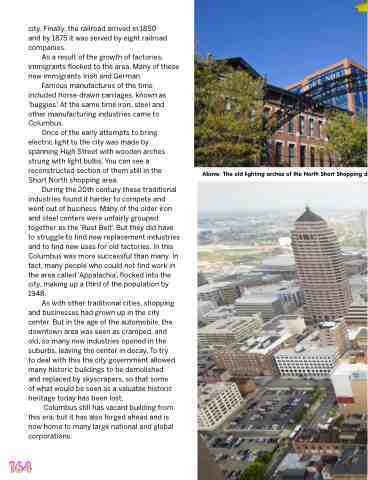
Once of the early attempts to bring electric light to the city was made by spanning High Street with wooden arches strung with light bulbs. You can see a reconstructed section of them still in the Short North shopping area.
During the 20th century these traditional industries found it harder to compete and went out of business. Many of the older iron and steel centers were unfairly grouped together as the ‘Rust Belt’. But they did have to struggle to find new replacement industries and to find new uses for old factories. In this Columbus was more successful than many. In fact, many people who could not find work in the area called ‘Appalachia’, flocked into the city, making up a third of the population by 1948.
As with other traditional cities, shopping and businesses had grown up in the city center. But in the age of the automobile, the downtown area was seen as cramped, and old, so many new industries opened in the suburbs, leaving the center in decay. To try to deal with this the city government allowed many historic buildings to be demolished and replaced by skyscrapers, so that some of what would be seen as a valuable historic heritage today has been lost.
Columbus still has vacant building from this era, but it has also forged ahead and is now home to many large national and global corporations.
Above: The old lighting arches of the North Short Shopping d
164
i


