


Page 16 - Curriculum Visions Dynamic Book
P. 16
16
14, 1862. Its capital was at Mesilla, in New Mexico. The North claimed the Salt River Valley as part of the Arizona Territory, formed by Congress in 1863 with its capital at Fort Whipple. However, the Phoenix area had no military value, and there was no fighting in this area.
So it was miners who first settled near what is now Phoenix, setting up camp in 1863 and calling it Wickenburg.
Then the U.S. Army set up Fort McDowell on the Verde River in 1865 to quell Native American uprisings. In order to create
a supply of hay for their needs, the fort established a camp on the south side of the Salt River in 1866.
The history of the city begins with Jack
Swilling, a Confederate veteran, part time farmer and part-time highway robber, who in November, 1867 on a visit to the Fort’s camp was the first to realize there were farming opportunities in the Salt River Valley. He saw the ruins of Hohokam canals and this gave him the idea to do the same on a bigger
scale. He raised funds from local gold miners to found the Swilling Irrigating and Canal Company. A group of 17 miners then began
to build the canals. It was supposedly English miner Darrell Dupa, who suggested they name the new farming settlement ‘Phoenix’ because they were raising the canal as from the ashes of the Hohokam system.
The Phillip Darrell Duppa adobe homestead house built around 1870 is one
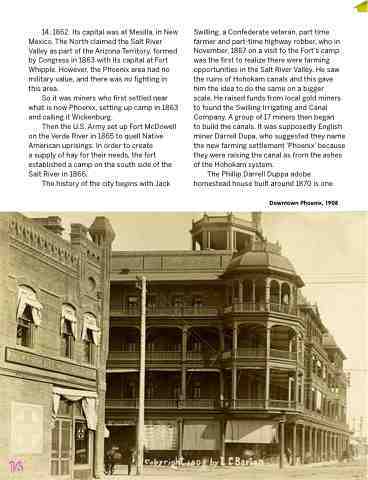
Downtown Phoenix, 1908.


