


Page 124 - Curriculum Visions Dynamic Book
P. 124
dramatically when gold was found in the Idaho Territory in the early 1860s. Many prospectors poured into the region. The gold was found in river beds, so the men were placer miners. There were gold rushes at Grasshopper Creek (which would develop into the community of Bannack) and Alder Gulch (which would become Virginia City). Indeed, so many people arrived in the region that the federal government created a new territory called Montana in May 1864. Also in 1864 one group of prospectors from Georgia found gold in the Prickly Pear Creek. They set up a mining camp and called it Last Chance Gulch.
Within a few months the four prospectors had been joined by 200 more.
It was now a substantial settlement and so a change of name was proposed, as well as a plan to lay out the streets of what they hoped would be a prosperous town, especially for the merchants who came to serve the miners with their needs. All kinds of names were suggested, such as Tomah, Pumpkinville
and Squashtown (as the meeting was held the day before Halloween). Other people suggested Minnesota town names as many had come from this area. The suggestion that was adopted came from John Summerville, who proposed Helena, in honor of Helena
Township, Scott County, Minnesota where he came from.
The site was surveyed and laid out in 1865 by Captain John Wood. He had an unusually difficult task because the town site was already surrounded by claims, and there was a gulch to cross. Many miners had already worn paths of their own. So, unlike many other cities that were laid out in a
grid pattern with even-sized blocks, Wood had to develop something to fit, and this is why the old city blocks vary in size.
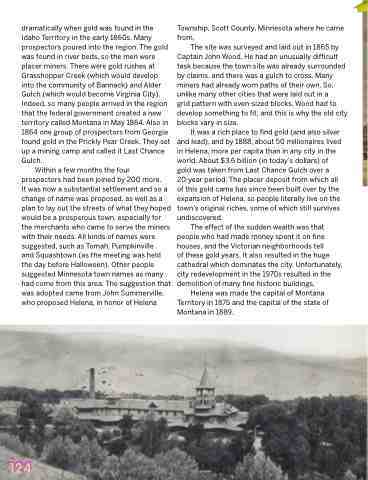
It was a rich place to find gold (and also silver and lead), and by 1888, about 50 millionaires lived in Helena, more per capita than in any city in the world. About $3.6 billion (in today’s dollars) of gold was taken from Last Chance Gulch over a 20-year period. The placer deposit from which all of this gold came has since been built over by the expansion of Helena, so people literally live on the town’s original riches, some of which still survives undiscovered.
The effect of the sudden wealth was that people who had made money spent it on fine houses, and the Victorian neighborhoods tell
of these gold years. It also resulted in the huge cathedral which dominates the city. Unfortunately, city redevelopment in the 1970s resulted in the demolition of many fine historic buildings.
Helena was made the capital of Montana Territory in 1875 and the capital of the state of Montana in 1889.
124


