


Page 110 - Curriculum Visions Dynamic Book
P. 110
of Saint-Paul by Father Lucien Galtier, a priest from France, in honor of Paul the Apostle. The Saint Paul log cabin chapel he built eventually developed into the Saint Paul Cathedral.
By this time the Native Americans had sold their land and had been moved ever farther west, opening the area to settlers. By the early 1840s Saint Paul was a recognized stopping point for settlers heading west, and this gave great trading possibilities for the town’s businesses.
Then, in 1849, the Minnesota Territory was created. It was an area with few settlements, and Saint Paul was the largest and easiest to get to (in the days before the railroad) so it was chosen as the capital. By 1858, Saint Paul was the capital city of the state of Minnesota.
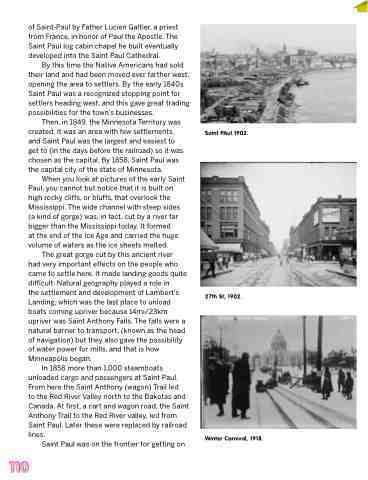
When you look at pictures of the early Saint Paul, you cannot but notice that it is built on high rocky cliffs, or bluffs, that overlook the Mississippi. The wide channel with steep sides (a kind of gorge) was, in fact, cut by a river far bigger than the Mississippi today. It formed
at the end of the Ice Age and carried the huge volume of waters as the ice sheets melted.
The great gorge cut by this ancient river had very important effects on the people who came to settle here. It made landing goods quite difficult. Natural geography played a role in
the settlement and development of Lambert’s Landing, which was the last place to unload boats coming upriver because 14mi/23km upriver was Saint Anthony Falls. The falls were a natural barrier to transport, (known as the head of navigation) but they also gave the possibility of water power for mills, and that is how Minneapolis began.
In 1858 more than 1,000 steamboats unloaded cargo and passengers at Saint Paul. From here the Saint Anthony (wagon) Trail led
to the Red River Valley north to the Dakotas and Canada. At first, a cart and wagon road, the Saint Anthony Trail to the Red River valley, led from Saint Paul. Later these were replaced by railroad lines.
Saint Paul was on the frontier for getting on
Saint PAul 1902.
27th St, 1902.
110
Winter Carnival, 1918.


