Explore these further resources...
(These links take you to other parts of our web site, never to outside locations.)
You can search in these books:



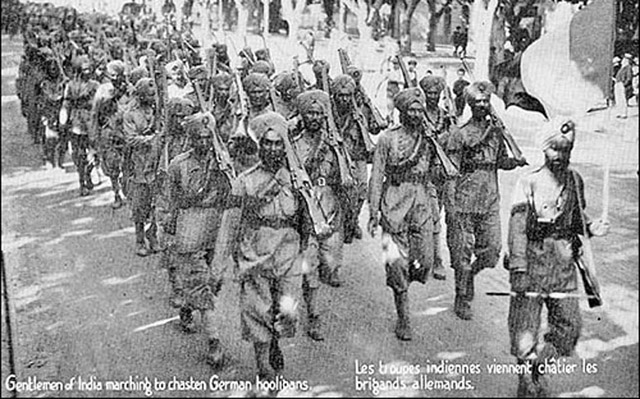
Sikh soldiers serving during World War I.
In 1914 Europe was divided into rival alliances. The immediate crisis began when Archduke Franz Ferdinand of Austria-Hungary was assassinated at Sarajevo. Austria-Hungary declared war on Serbia, and alliance promises helped pull the great powers into the conflict.
Britain, France and Germany ruled overseas empires, so soldiers, workers and resources were drawn from many parts of the world. Fighting also took place in Africa, the Middle East, Asia and at sea.
↑ ContentsThere was no single cause. European powers competed for colonies, built up armies and navies, and feared their neighbours. Nationalism created tensions, especially in the Balkans, while military plans encouraged governments to act quickly when the crisis came.
The assassination was the spark, but the rivalries and alliances were the fuel. Once mobilisation began, leaders found it very difficult to stop the chain of declarations of war.
↑ ContentsOn the Western Front, German forces were stopped before they could defeat France quickly. Both sides dug long systems of trenches from the Channel coast to Switzerland. Machine guns, artillery and barbed wire made attacking across open ground extraordinarily dangerous.
The front moved very little for long periods. Soldiers lived with mud, rats, noise, fear and disease, while commanders struggled to find a way through the enemy defences.
↑ ContentsModern industry supplied armies with weapons on an unprecedented scale. Artillery caused many casualties, while aircraft, tanks, poison gas and submarines introduced new dangers. Railways moved troops and supplies, and factories at home became part of the war effort.
Technology did not make the war quick. New attacking weapons were often matched by strong defensive weapons, and both sides could replace lost equipment and men for years.
↑ ContentsThe government recruited and later conscripted millions of men. Women took on many jobs in factories, transport, farming and hospitals, although they were often paid less than men. Food and raw materials were controlled, and German submarines tried to cut Britain off from overseas supplies.
Troops came from across the British Empire and Dominions, including India, Canada, Australia, New Zealand, Africa and the Caribbean. Their service is essential to understanding why this was a world war.
↑ ContentsThe United States remained neutral at first. German submarine warfare, including attacks that killed American citizens, increased hostility towards Germany. In 1917 Germany resumed unrestricted submarine warfare and the Zimmermann Telegram revealed an attempt to encourage Mexico to oppose the United States.
The United States declared war in April 1917. American money, supplies and eventually large numbers of fresh troops strengthened the Allies at a critical moment.
↑ ContentsRussia left the war after revolution in 1917, allowing Germany to move troops west. Germany launched a major offensive in spring 1918, but it failed. Allied forces then advanced, supported by growing American strength, while Germany and its allies faced hunger, exhaustion and unrest.
An armistice stopped the fighting on the Western Front at 11 a.m. on 11 November 1918. Peace treaties followed, including the Treaty of Versailles in 1919.
↑ ContentsMillions of military personnel and civilians died, and many more were wounded or displaced. Empires collapsed, borders changed and new countries appeared. The peace settlement left bitterness and problems that later helped create the conditions for another world war.
Remembrance Day is held on 11 November. Poppies became a symbol of remembrance because they grew on disturbed ground in areas devastated by the fighting.
↑ ContentsVideo: Why we remember World War I.
Video: Silent film of the front and the trenches.