What is a volcano? A volcano is a place where molten rock, gases and sometimes ash reach Earth's surface.
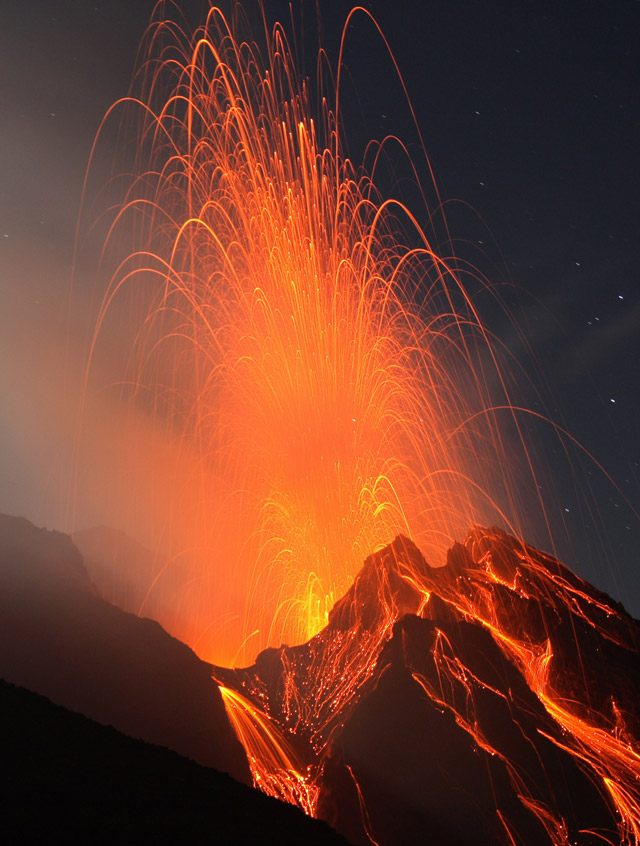
Stromboli: a volcano built by repeated eruptions.
WHAT IS A VOLCANO?
A volcano is a place where molten rock from inside Earth reaches the surface. Below ground it is magma; at the surface it is lava. Repeated eruptions can build a volcanic mountain from layers of lava, ash and rock.
Earth’s outer rocky layer is broken into moving plates. Volcanoes are common near plate edges. Where plates pull apart, magma can rise through cracks. At a subduction zone one plate is forced beneath another; conditions above the sinking plate can lead to magma forming and rising through weaknesses.
Magma can contain gases dissolved in it under great pressure. As magma rises, pressure falls and gas forms growing bubbles. If gas escapes easily, lava may flow quietly; if gas is trapped, pressure can build and an eruption can be explosive. This is a physical process, not a chemical reaction. Vinegar and alkali therefore give the wrong idea. A shaken fizzy-drink bottle is a closer simple comparison because lowering the pressure lets dissolved gas form bubbles and escape.
Runny magma lets gas escape more easily and can produce lava fountains and long flows. Stickier magma can trap gas and produce violent explosions, ash and fast-moving hot mixtures of gas and ash. Volcanoes do not all erupt in the same way.
A cone-shaped volcano usually has a vent through which magma rises and a crater around the opening. Eruption after eruption adds material. Broad gentle volcanoes are often built by lava that travels farther; steeper cones can contain shorter lava flows and layers of ash and broken rock.
Lava cools from liquid to solid volcanic rock. Explosive eruptions can break magma into tiny pieces called volcanic ash, with larger cinders and volcanic bombs. Volcanic ash is fine rock material, not the ash left by a wood fire.
Magma may cool underground in cracks or larger bodies. Erosion can later uncover these harder rocks. An old vent may remain as a volcanic plug. A large collapsed crater, or caldera, may fill with water. Underground heat can also help produce hot springs and geysers.
Volcanoes can threaten people with lava, ash, gases and hot ash clouds. Scientists watch active volcanoes for small earthquakes, changes in the ground and changes in gases. People also live near volcanoes because volcanic areas can provide fertile soils, useful rocks and geothermal energy.
The toolkit screen link will take you to a library containing a selection of:
an i-topic, more books, pictures, videos and teacher's stuff related to the search word.