Explore these further resources...
(These links take you to other parts of our web site, never to outside locations.)
You can search in these books:



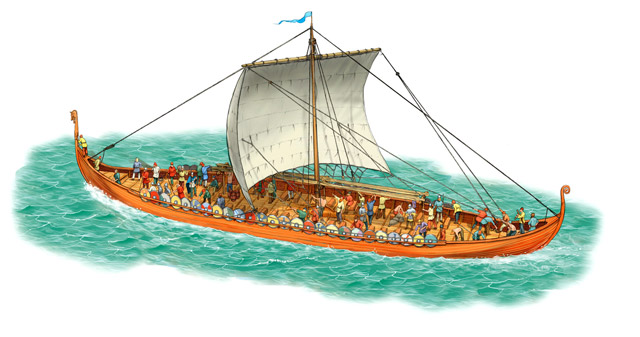
Viking longship.
The Vikings lived in Denmark, Norway and Sweden, on the other side of the North Sea from the British Isles. They were farmers and fishermen who also became traders, sailors and warriors.
The Viking Age in Britain began in the 8th century. In England it is usually taken to end in 1066, although Viking communities and influence continued much longer in parts of Scotland and elsewhere.
↑ ContentsViking ships made long-distance travel possible. Their crews could cross open seas, approach coasts quickly and use rivers to reach far inland.
Ships were used for more than warfare. They carried people, animals and goods, linking Scandinavian communities with trading places and settlements across a very wide area.
↑ ContentsFor about fifty years many Viking attacks on Britain were hit-and-run raids. Small groups arrived, took valuables and left again.
Later, some Vikings began to stay. The change from raiding to settlement transformed the relationship between Scandinavia and Britain.
↑ ContentsNorwegian Vikings settled especially in the islands of northern Scotland and on the east coast of Ireland. Viking settlement also reached Normandy in northern France.
Danish Vikings became especially important in England. In the 9th century large forces arrived and took control of extensive areas in the east.
↑ ContentsThe Danish invasions became much larger when thousands of warriors arrived as a Great Army. They captured territory and forced Anglo-Saxon kingdoms to respond.
Large parts of eastern and northern England came under Viking rule. The area later known as the Danelaw developed settlements, laws and place names that reflected Scandinavian influence.
↑ ContentsThe Vikings met resistance from the English, Scots and Irish. The most famous Anglo-Saxon king to fight them was Alfred, who prevented the Vikings from taking the whole of England.
The struggle continued for roughly two centuries. At different times Anglo-Saxon kings or Viking rulers held the advantage.
↑ ContentsViking settlements were not simply military camps. Farmers, craftspeople and traders lived in them. Workshops produced useful and decorative objects, and markets exchanged local and imported goods.
Harbours, beaches and wooden walkways mattered because movement by water was central to Viking life. A settlement connected to sea routes could become a busy trading place.
↑ ContentsMany Vikings settled permanently. Their language influenced English, and Scandinavian place names still survive in many parts of Britain.
Viking ancestry also became part of the population. Even after the age of invasion ended, the people who had settled did not simply disappear: their communities became part of later Britain.
↑ ContentsVideo: An introduction to the Vikings.