When was the Stone Age? The Stone Age was the long period before people began to use metals for their tools and weapons. In Britain it lasted for hundreds of thousands of years and ended only when bronze-working arrived.
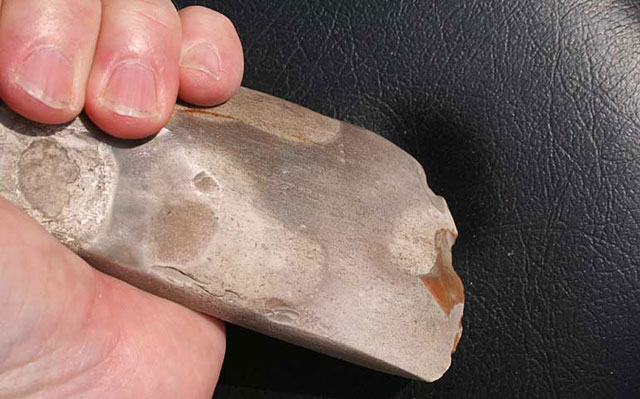
A Stone Age hand-axe.
WHAT DO WE MEAN BY THE STONE AGE?
The Stone Age was not one short episode. It was an enormous stretch of human history during which stone was the main material used for cutting tools. People also used wood, bone, antler, hide and plant fibres, but these usually rot away, so stone tools are some of the evidence that survives best.
Historians divide the Stone Age into the Old Stone Age, or Palaeolithic, the Middle Stone Age, or Mesolithic, and the New Stone Age, or Neolithic. The change from one stage to another did not happen everywhere at the same moment. New ways of living spread slowly, and people adapted them to local conditions.
Nor does “Stone Age” mean that people were stupid or incapable. They understood animals, plants, weather and landscapes in ways that were essential for survival. Over time they learned to make increasingly specialised tools, build substantial homes, farm, weave, make pottery and organise large communal projects.
For most of the Stone Age, Britain was a very different place from today. During colder periods ice sheets covered large areas, while farther south there were open grasslands and tundra. Mammoths, woolly rhinoceroses, reindeer and other cold-climate animals moved across these landscapes.
People lived as hunter-gatherers. They did not have permanent farms or villages. Small groups moved as seasons changed, following animals and finding edible plants, nuts, roots and berries. A good knowledge of the landscape mattered as much as a good weapon: people had to know where animals crossed rivers, where stone for tools could be found and where shelter was available.
The climate changed repeatedly. When the ice finally retreated, sea levels rose. The low land that had linked Britain to mainland Europe was gradually flooded, and Britain became an island. The people living here had to adapt to forests, rivers, wetlands and coastlines instead of the open Ice Age landscape.
Stone tools were carefully made, not simply picked up from the ground. A toolmaker struck flakes from a piece of flint or another suitable stone until it had the required shape and edge. Some tools were then ground and polished. Making a good axe or arrowhead demanded skill and experience.
Different tools did different jobs. Hand-axes could cut meat, wood and other materials. Scrapers helped prepare animal skins. Later, tiny sharp flints could be fixed into wooden or bone shafts to make arrows and other composite tools. In the Neolithic, polished axes became important for clearing woodland as people created fields.
Farming brought new tools. Sickles cut crops. Querns were used to grind grain into flour. A saddle quern was a broad lower stone on which grain was crushed by rubbing another stone backwards and forwards. These objects show a major change: people were increasingly producing food rather than simply finding it.
Stone Age people left more than tools. In parts of Europe they painted and engraved animals on cave walls and made small carved objects. Horses, bison, deer and other animals were drawn with remarkable observation and skill.
We cannot know exactly why the paintings were made. They may have been connected with stories, ceremonies, hunting or beliefs about the natural world. That uncertainty is important: archaeology gives us evidence, but the evidence does not always tell us exactly what people were thinking.
The paintings do tell us that Stone Age communities had imagination, memory and traditions. Someone had to prepare pigments, provide light deep inside caves and learn how particular animals should be represented. Art was part of human life long before writing existed.
By the Neolithic, some communities buried their dead in substantial monuments. Long barrows were long earth mounds, sometimes built over chambers made from large stones. They were not simply graves for one person; some were used repeatedly.
Building one required many people to work together. Stone and timber had to be moved, earth piled up and the whole structure maintained. That suggests communities could organise labour for purposes that went far beyond finding food.
Burial places also remind us that people had strong connections with particular landscapes. A monument could remain visible for generations. The living would know where their ancestors had been placed, even though we cannot be certain what beliefs or ceremonies surrounded the burials.
Late Stone Age communities also built monuments using enormous standing stones. Stonehenge is the most famous, but it was only one part of a much larger ceremonial landscape containing banks, ditches, burial mounds and routes used by people over a long period of time.
The stones at Stonehenge came from more than one place, and some had to be transported over considerable distances. Raising them required planning, ropes, timber, labour and an understanding of how heavy objects could be moved and balanced.
Its arrangement also shows connections with the Sun at particular times of year. But Stonehenge was changed and rebuilt over centuries, so there is unlikely to be one simple explanation for everything that happened there. Its importance lies partly in the fact that generations of people kept returning to the same place.
A henge is not, strictly speaking, a ring of stones. It is a circular or oval enclosure defined by a bank and an internal ditch. Some henges contained timber circles or stone circles; others did not. Avebury is one of the largest and most impressive examples.
These places must have drawn people together. Families who normally lived in scattered farms and small settlements could meet, exchange goods, arrange marriages, take part in ceremonies and renew links with other groups.
That makes the great monuments evidence for society as well as religion. They show that Neolithic Britain was made up of connected communities able to cooperate on projects that might take years to complete. The Stone Age story is therefore not just a story of tools; it is also a story of people learning to live together in increasingly organised ways.
One of the greatest changes of the Stone Age came when farming spread into Britain. Instead of relying entirely on wild food, people kept animals and grew crops. This did not mean hunting and gathering suddenly stopped, but farming made it possible for families to stay in one area for much longer.
Settled life changed the landscape. Woodland was cleared for fields and grazing. Grain had to be harvested, stored and ground. Animals needed to be managed. Pottery became useful for cooking and storage, while weaving provided another way of making clothing and household materials.
A farm also meant investment in a place. Houses, fields, paths and storage all took work to create. Family life became tied more closely to particular patches of land. Archaeologists can sometimes trace these changes from post holes, charred grain, animal bones, pottery, stone tools and the marks left by buildings that disappeared thousands of years ago.
Skara Brae in Orkney gives us an unusually detailed look inside a Neolithic settlement. Most Stone Age houses were built partly from timber and other materials that decayed, but at Skara Brae local stone was used extensively. Wind-blown sand later covered the settlement and helped preserve it.
The houses were built partly into the ground and surrounded by midden — accumulated household waste — which helped protect them from the fierce Atlantic weather. Low, roofed passages linked houses and sheltered the entrances. Inside, the stone fittings allow us to recognise beds, storage spaces, a central hearth and the distinctive stone “dresser” opposite the entrance.
Life there depended on much more than simply having a stone house. People kept animals, grew crops, fished and collected shellfish. They made pottery, tools and containers, prepared food and repaired their homes. Beds could be made more comfortable with skins, heather and other soft material, while stone walls and sheltered entrances helped keep out wind.
Skara Brae is therefore valuable because it turns the Stone Age from a collection of objects into a home. We can ask where people slept, cooked, stored possessions and worked. We can imagine families moving through the passages in winter storms. The settlement does not tell us everything, but it brings us unusually close to the daily lives of people who lived more than five thousand years ago.
The toolkit screen link will take you to a library containing a selection of: an i-topic, more books, pictures, videos and teacher's stuff related to the search word.