Explore these further resources...
(These links take you to other parts of our web site, never to outside locations.)
You can search in these books:



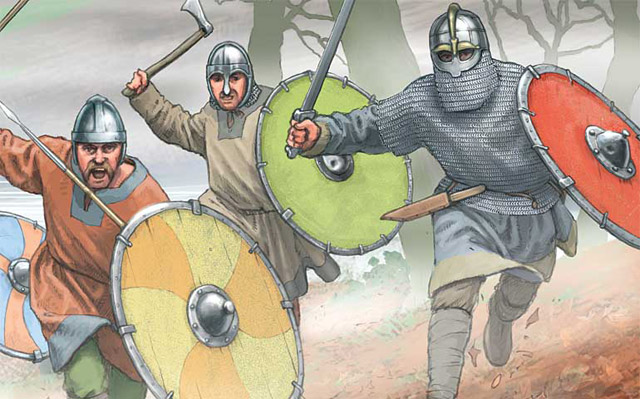
A band of Saxons on a raid.
The Anglo-Saxons lived and ruled in much of Britain between about 1,500 and 1,000 years ago. They came from lands we now call Denmark, north-western Germany and the Netherlands.
They were not one single people. The largest groups included the Angles, Saxons and Jutes. Over time their settlements and kingdoms became what we call Anglo-Saxon England.
↑ ContentsWhen Roman control weakened and then ended, the people already living in Britain had to defend themselves without the Roman army. Attacks came from several directions, including from Irish and Scottish raiders.
According to the traditional story, Anglo-Saxon warriors were first paid to help defend Britain. They were experienced fighters and had already raided British shores during the late Roman period.
↑ ContentsAnglo-Saxon raiders used small, light boats that could travel up rivers. This made it possible to reach places that larger Roman-style vessels could not easily follow.
What began as raiding and hired fighting gradually became settlement. Demands for payment and land grew, and more people crossed the North Sea to claim land and build new communities.
↑ ContentsAnglo-Saxon England was divided into kingdoms rather than ruled as one country from the beginning. Kings competed for power, made alliances and fought one another as well as outside enemies.
Over the centuries these kingdoms changed. Their rulers built churches, towns and centres of trade, and Christianity became an important part of Anglo-Saxon life.
↑ ContentsRich burials show that Anglo-Saxon society could contain powerful rulers and skilled craftspeople. Sutton Hoo is famous for a ship burial beneath a mound and for remarkable objects buried with the dead.
Objects such as weapons, jewellery and imported goods can be used as evidence. They help archaeologists ask who was buried, how powerful that person was and how far Anglo-Saxon connections reached.
↑ ContentsMost people lived by farming and craft work. Settlements contained simple timber houses, workshops and places where goods could be exchanged.
Some fortified towns, or burhs, grew at important crossings and routes. Markets brought together farmers, craftspeople and traders and helped towns become centres of local life.
↑ ContentsAnglo-Saxon rulers had to defend land against rivals and, later, Viking armies. Earth banks, ditches and defended towns could protect important routes and settlements.
King Alfred became famous for resisting Viking conquest. The struggle did not end quickly: control shifted between Anglo-Saxon and Viking rulers for generations.
↑ ContentsAnglo-Saxon rule in England ended in 1066 after a year of invasions and battles. King Harold fought one invading army in the north and then hurried south to meet William of Normandy.
The Battle of Hastings brought a new ruling dynasty to England. Yet Anglo-Saxon language, place names, farming landscapes and many customs continued long after the conquest.
↑ ContentsVideo: A Saxon fortified town.
Video: Saxon times.