PART 1: ANCIENT ROME
MEET THE ROMANS
The Romans began in the city of Rome in Italy. Over many centuries they took control of lands around the Mediterranean and far beyond it. At its greatest extent, the Roman Empire stretched from Britain to North Africa and the Middle East.
People across this enormous empire did not all become the same. They kept many local customs, languages and foods. But Roman government, money, law, towns, roads and the army helped hold the empire together.
↑ Contents
ROMAN GODS AND TEMPLES
Romans worshipped many gods and goddesses. Some, such as Jupiter, Juno, Mars and Venus, were closely linked with Greek gods but were given Roman names and Roman stories.
Temples were places where people honoured the gods and made offerings. Religion was also part of public life: festivals, ceremonies and sacrifices were connected with the success of the city and the empire. Later, Christianity spread through the empire and eventually became its official religion.
↑ Contents
THE ROMAN ARMY AND FAMOUS LEADERS
Rome could not have built or protected an empire without its army. Legionaries were trained soldiers who fought in organised units. The army also built forts, roads and bridges, so soldiers helped to change the places Rome conquered.
Roman history is full of powerful leaders. Julius Caesar was a general and politician, not an emperor. After his death, Augustus became Rome's first emperor. Later emperors ruled a huge territory through governors, officials and the army.
↑ Contents
HOW THE CITY OF ROME WORKED
Rome grew into one of the largest cities of the ancient world. A city of hundreds of thousands of people needed water, food, housing, streets, markets and public services every day.
Aqueducts brought water from distant springs. Grain and other foods arrived in huge quantities, much of it by sea through the port of Ostia. Warehouses stored supplies before they were distributed through the city.
Wealthy families might live in a private house called a domus, but many people lived in multi-storey blocks called insulae. Baths, fountains, food shops and other shared services mattered because ordinary homes did not contain all the facilities of a modern house.
↑ Contents
THE FORUM, COLOSSEUM AND ARENA
The Forum was an important centre for government, religion, business and public life, but a city as large as Rome had many busy centres and neighbourhoods.
The Colosseum was an enormous arena used for public spectacles, including gladiatorial contests. Romans also went to theatres, public baths and chariot races. These famous buildings were important, but most Roman days were spent working, shopping, eating and looking after families rather than watching spectacles.
↑ Contents
HOMES, FOOD AND EVERYDAY LIFE
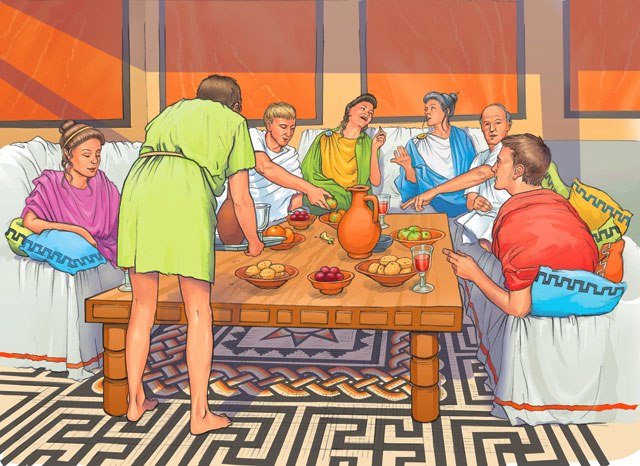
Roman life depended greatly on wealth. Rich homes could have courtyards, decorated rooms, mosaics and enslaved servants. Poorer families often had much less space and fewer facilities.
Markets and street food were important. Bread, grain, olive oil, vegetables, fruit, fish and wine were common parts of the Roman diet, although what people ate depended on what they could afford.
Slavery was a major part of Roman society. Enslaved people worked in homes, farms, mines, workshops and many other occupations. Free people also worked as craftspeople, traders, labourers, soldiers and officials.
↑ Contents
ROADS, TRADE AND THE EMPIRE
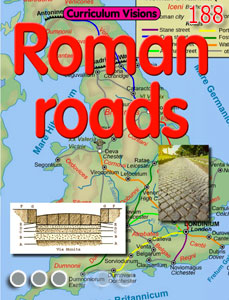
Roman roads helped armies, officials and messages move quickly across the empire. For heavy goods, however, transport by river and sea was usually much cheaper. Mediterranean shipping connected ports and cities across great distances.
The empire supplied Rome with taxes and resources. Grain came from provinces including Egypt and North Africa, while other regions supplied metals, pottery, oil, wine and many other goods. Rome was therefore not an isolated city: it depended on the enormous empire around it.
↑ Contents
PART 2: ROMANS IN BRITAIN
BRITAIN BEFORE THE ROMANS
When Roman armies arrived, Britain was already a settled farming land with villages, hillforts, craftspeople and trade. Different peoples and tribal kingdoms controlled different areas.
Britain had long traded with continental Europe. The Romans therefore knew that Britain had useful farmland and valuable resources. Conquest brought these lands and people into the Roman tax system and Roman Empire.
↑ Contents
CAESAR, CLAUDIUS AND INVASION
Julius Caesar led expeditions to Britain in 55 and 54 BC, but he did not make Britain a permanent Roman province. Nearly a century later, Emperor Claudius ordered a major invasion in AD 43.
The Roman army gradually conquered much of Britain. Conquest was not one battle or one moment: different regions were brought under Roman control at different times, and some areas resisted strongly.
↑ Contents
CARATACUS AND BOUDICCA
Some British leaders fought against Roman rule. Caratacus resisted Roman armies for years before he was captured. Later, Boudicca, queen of the Iceni, led a major rebellion in AD 60 or 61.
Boudicca's forces destroyed Roman settlements including Colchester, London and St Albans before the Roman army defeated the revolt. These conflicts remind us that becoming part of the Roman Empire was not peaceful or welcomed by everyone.
↑ Contents
FORTS, ROADS AND FRONTIERS
The army needed forts where soldiers could live and store supplies. Roads linked forts, towns and ports, allowing troops and messages to move rapidly. Settlements often grew beside important military sites and road junctions.
In northern Britain the Romans built frontier works including Hadrian's Wall and, farther north for a shorter period, the Antonine Wall. These were controlled frontiers with forts and crossing points, not simply walls intended to seal Britain in two.
↑ Contents
ROMAN TOWNS AND LONDON
Roman Britain developed towns with streets, markets, public buildings, temples and baths. Some grew from military settlements; others became centres for government and trade.
Londinium, Roman London, grew beside the River Thames into an important port and trading centre. Other towns included places that became modern Colchester, St Albans, Lincoln, York and Chester.
The pattern was a smaller version of Rome itself: people living together needed water, food supplies, roads, markets, administration and places to meet.
↑ Contents
HOMES, FOOD, LEISURE AND VILLAS
Life in Roman Britain varied enormously. Town houses, workshops and modest homes existed alongside large country houses called villas. Villas were often centres of farming estates as well as comfortable homes for wealthy families.
People cooked local foods but Roman rule also widened trade and introduced new tastes and goods. Baths, games and public entertainments became part of town life. Mosaics, pottery, coins and household objects help archaeologists reconstruct how people lived.
Outside towns, most people still depended on farming. Roman Britain was therefore both an urban and a countryside society.
↑ Contents
THE ROMANS LEAVE — WHAT REMAINED?
By the early 5th century AD, the western Roman Empire was under increasing pressure. Roman government and military support in Britain came to an end, and local communities had to organise themselves differently.
Roman rule disappeared, but its physical traces did not. Roads, town sites, walls, forts, villas and objects remained in the landscape. Archaeologists use them to discover how Britain changed during more than three centuries of Roman rule.
The most useful Roman legacy may be the questions their towns and empire allow us to ask: How do you supply a city? How do you connect distant places? How does government work across a large territory? And what happens when that system changes?
↑ Contents