Explore these further resources...
(These links take you to other parts of our web site, never to outside locations.)
You can search in these books:



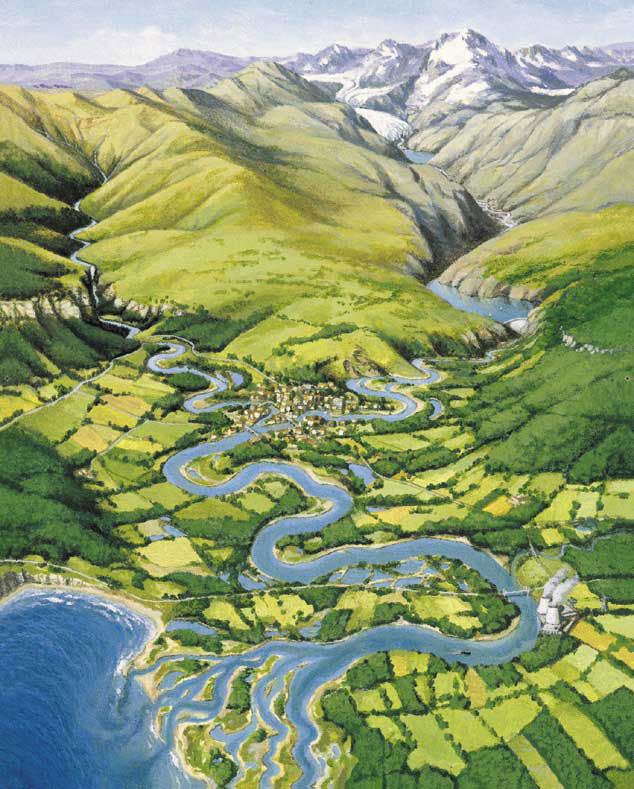
A river and the land that drains water into it.
A river is more than the water we can see between its banks. Rain falls over a wide area of land. Some water soaks into the soil and rock, some is taken up by plants, and some flows over the surface. Much of it eventually finds its way into streams and rivers.
Small streams join larger streams. These join rivers, and the rivers carry the water downhill. A smaller river that joins a larger one is called a tributary. The place where two rivers meet is called a confluence.
↑ ContentsThe whole area of land that supplies water to one river is called its drainage basin, or river basin. The high land around the edge of the basin forms a boundary called the watershed. Rain falling on one side of a watershed may flow into one river, while rain on the other side may flow into a completely different river.
Soil and some rocks can hold water rather like a sponge. Water may move slowly through them before reaching the river. This is one reason a river can keep flowing even when it has not rained for several days.
↑ ContentsA river begins at its source, often on high ground. Near the source the channel is usually narrow and the slope is steep. This is called the upper course.
Farther downstream, more tributaries have joined it. The river becomes wider and usually carries more water. This is the middle course. Near the end of its journey the river is often broad and the land is flatter. This is the lower course.
The river ends at its mouth. Some rivers enter the sea through an estuary. Others split into smaller channels and build a delta from mud and sand that the river has carried downstream.
↑ ContentsRivers make many features. In steep country they can cut narrow valleys. A sudden hard step in the river bed may make a waterfall, with a deep pool below it.
On gentler land, a river often bends from side to side. These bends are called meanders. During floods, water may spread across the flat land beside the river. This flat area is the floodplain.
The river channel has two banks and a bed. The fastest current is not always in the middle: it depends on the shape of the channel and the bends in the river.
↑ ContentsFlowing water can wear away its bed and banks. This is called erosion. The river can then carry pieces of rock, sand and mud. This is called transport.
When the river slows down, it may drop some of the material it is carrying. This is called deposition. Erosion, transport and deposition work together to change the river valley.
These changes are usually slow, but during a flood a river can move a great deal of material in a short time.
↑ ContentsIf rain falls for a long time, the soil can become full of water. Extra rain then runs over the surface and reaches streams quickly. Very heavy rain can do the same thing because it may fall faster than the ground can soak it up.
The river level rises. If more water reaches the channel than it can carry, water spills over the banks onto the floodplain. Floodplains are therefore natural parts of many river valleys, even though building on them can put homes and roads at risk.
↑ ContentsPeople have built settlements beside rivers for thousands of years. Rivers provided fresh water for people and animals, water for crops, fish for food and, in many places, a useful route through the landscape.
Flat valley floors also made building easier. Bridges and crossing places often became important meeting points, and towns sometimes grew around them. But living close to a river also brought the danger of flooding.
↑ ContentsBefore railways and modern roads, moving heavy goods over land was slow and expensive. Boats could carry much larger loads, so navigable rivers became important trade routes.
Ports, wharves and warehouses grew beside rivers. Goods could be brought inland from the sea or carried from farms and towns to larger markets. This is why many important cities developed beside major rivers.
Rivers are still used for transport today, although roads and railways now carry much of the traffic. Their importance can still be seen in the position of many old towns, ports and industrial areas.
↑ ContentsVideo: How rivers work.
Video: From rain to stream.