Explore these further resources...
(These links take you to other parts of our web site, never to outside locations.)
You can search in these books:



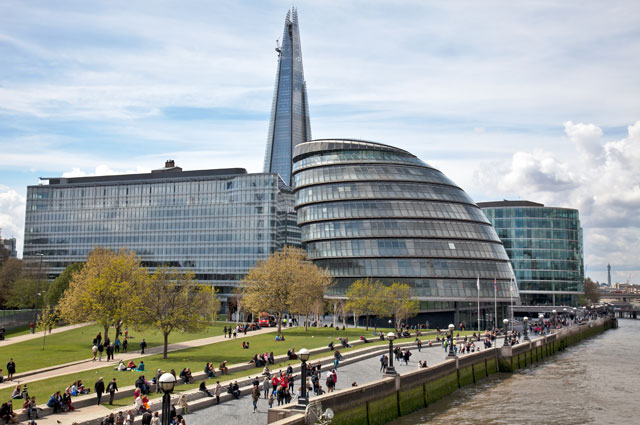
London City Hall beside Tower Bridge: old and new landmarks stand side by side.
In 1945 Britain had won the war but faced bomb damage, debt and shortages. Food rationing continued for years, and many families needed better homes. The government began a huge programme of rebuilding.
The post-war years were difficult, but they also brought ambitious plans to improve everyday life. New towns, council housing, schools and public services changed communities across the country.
↑ ContentsThe government expanded the welfare state to protect people from hardship caused by unemployment, illness and old age. In 1948 the National Health Service began, providing health care funded through taxation and available to everyone.
These changes did not remove poverty or inequality, but they changed what people expected government and public services to provide.
↑ ContentsAfter the war, independence movements grew across the British Empire. India and Pakistan became independent in 1947, and many other territories followed during the 1950s and 1960s.
Britain was no longer the centre of a vast empire. Many former colonies joined the Commonwealth, a voluntary association of independent countries, while Britain had to rethink its economic and political role.
↑ ContentsPeople came to Britain from the Caribbean, South Asia, Africa and elsewhere to work and build new lives. The arrival of HMT Empire Windrush in 1948 became a symbol of post-war Caribbean migration, although Black communities already had a much longer history in Britain.
Migrants helped staff transport, factories and the NHS and transformed British culture. Many also faced racism and discrimination, leading to campaigns for equal rights.
↑ ContentsDuring the 1950s and 1960s wages and living standards generally rose. More households gained televisions, refrigerators, washing machines and cars. Teenagers became a distinct consumer group, and popular music and fashion changed rapidly.
Traditional heavy industries later declined, causing unemployment in many industrial areas. Service industries, finance, retail, education, technology and creative work became more important.
↑ ContentsWomen gained wider opportunities in education and employment, while campaigns pressed for equal pay and protection from discrimination. Laws and attitudes also changed concerning race, disability and sexuality, although equality remained unfinished.
Northern Ireland experienced decades of conflict known as the Troubles. The 1998 Good Friday Agreement created a new basis for shared government and a more peaceful future.
↑ ContentsBritain joined the European Economic Community in 1973. The organisation developed into the European Union. After a referendum in 2016, the United Kingdom left the EU in 2020, a process known as Brexit.
Britain remained a member of NATO and the United Nations Security Council and maintained close links with the Commonwealth and United States. Debate continues about how Britain should work with its neighbours and the wider world.
↑ ContentsComputers, the internet and mobile phones transformed communication, entertainment and many kinds of work. Scientific and medical advances changed lives, while globalisation connected Britain more closely to world trade and events.
Modern Britain continues to face questions about inequality, housing, energy, climate change and national identity. History helps us see that the country we know was made through choices and changes, not simply by the passage of time.
↑ Contents