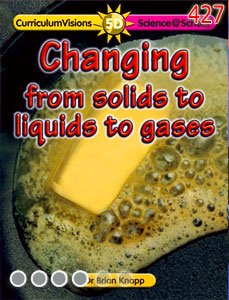
When you heat some solid substances like butter they become soft, and then turn into a liquid. Others change suddenly. In both cases ee say that they have melted and become molten.
Melting happens when the particles of a substance stop holding each other together tightly, so the particles can slip over one another. When something is fully molten it is a liquid. Some substances melt over a range of temperatures because they are mixtures of things. Butter is like this. On the other land, pure substances melt at a fixed temperature. Ice is like this.
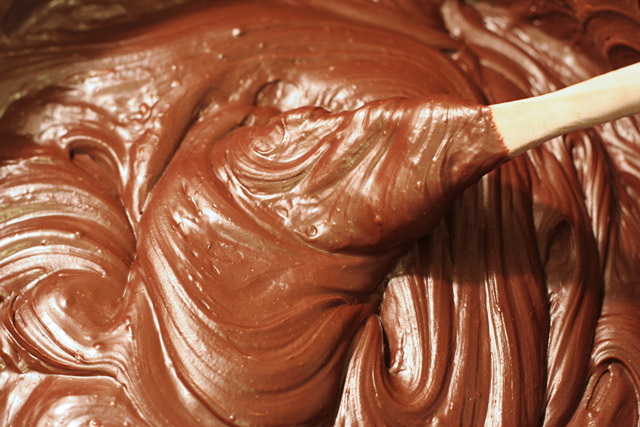
Some substances like butter and chocolate do not need much heat to melt them. Chocolate melts at about 38°C, which is why it melts on your fingers, but other substances need much higher temperatures to melt. Metals, for example, need to be very hot. Iron can be melted if it is heated to 1536°C. That is over fifteen times hotter than a boiling kettle.
When a molten substance is allowed to cool down again it turns back into a solid.