What was the Iron Age? The Iron Age followed the Bronze Age. People learned to make useful objects from iron, while Britain became a land of farms, settlements, hill forts and many different kingdoms.
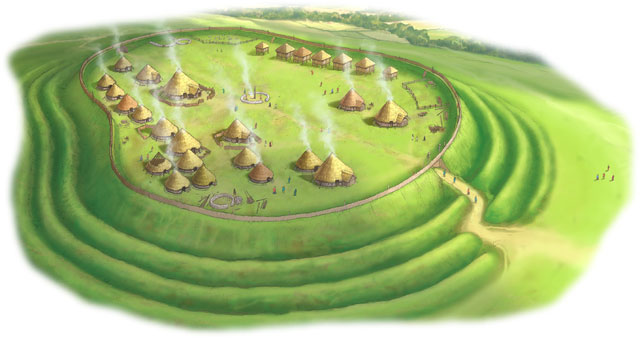
An Iron Age fort.
The Iron Age
Iron working required very high temperatures, charcoal and a good supply of air from bellows. Once people mastered the process, iron could be forged into strong tools and weapons.
Iron did not make bronze, wood or stone disappear. It simply gave craftspeople another material with useful properties.
Iron Age Britain was divided among many peoples, tribes and kingdoms rather than ruled as one country. Names later recorded include the Iceni, Brigantes, Catuvellauni and others.
These kingdoms traded, made alliances and sometimes fought. This political landscape is important because it was the Britain the Romans encountered.
Many people still lived in round houses built from timber, woven branches, mud and thatch. Settlements ranged from small farmsteads to larger communities.
By the later Iron Age some places were becoming important centres for craft, exchange and leadership, although they were very different from later Roman towns.
Most people still depended on farming. They grew crops, kept animals and stored food to carry them through the year. Iron tools could make some jobs easier, but farming remained labour-intensive.
Food stores were valuable. A poor harvest, theft or warfare could threaten the survival of a community.
Hill forts were defended places surrounded by banks, ditches and sometimes timber palisades. Some were occupied permanently; others may have been gathering places or refuges used at particular times.
Their defences show that land, livestock and stored food could be worth protecting. They also show the ability of communities to organise large amounts of labour.
In parts of northern and western Scotland, people built impressive stone towers called brochs. Thick dry-stone walls contained passages and chambers, creating strong and distinctive buildings.
Brochs remind us that Iron Age Britain was not the same everywhere. People adapted buildings to local materials, traditions and needs.
Iron Age communities were linked by tracks, rivers and sea routes. Goods moved between regions, and some objects reached Britain from continental Europe.
Trade carried more than objects. New fashions, skills and ideas could move with travellers and merchants.
Iron Age religion is difficult to reconstruct because people left few written records of their own. Archaeology shows that special objects were sometimes placed in rivers, lakes, bogs or pits.
These deposits may have been offerings. Sacred places, seasonal ceremonies and beliefs about the natural world were probably important, but much remains uncertain.
When Rome began to intervene in Britain, it did not face a single British nation. Different kingdoms made different choices: some resisted, some negotiated and some became allies.
This helps explain why Roman conquest happened in stages and why leaders such as Boudicca could rebel while other British rulers cooperated with Rome.
Roman conquest changed Britain, but the people who already lived here did not disappear. Most continued to farm and raise families, while Roman buildings, trade, government and customs were added to existing ways of life.
The story after conquest is therefore one of mixture and change rather than one people simply replacing another.
The toolkit screen link will take you to a library containing a selection of:
an i-topic, more books, pictures, videos and teacher's stuff related to the search word.