Explore these further resources...
(These links take you to other parts of our web site, never to outside locations.)
You can search in these books:




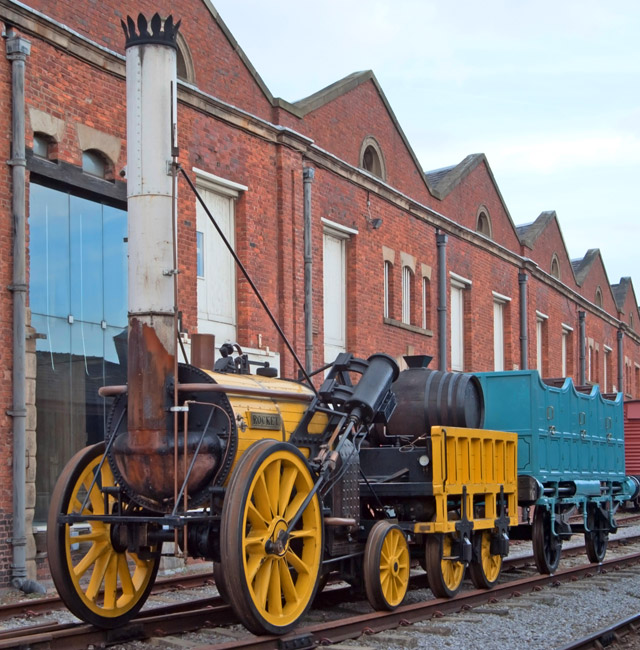
Stephenson's Rocket shows how steam power moved from factories and mines onto the railway.
For most of history, nearly everything was made by hand. Cloth was spun and woven in cottages, metal goods were made in small workshops, and most people lived in the countryside. During the 1700s this began to change rapidly in Britain.
New machines could do work much faster than people working by hand. Water power and then steam power drove those machines. Instead of work being spread among many small homes and workshops, more and more production was gathered into factories. The change was not one single invention. It was a chain reaction in farming, energy, machines, transport, towns and trade.
↑ ContentsIndustry could grow only if enough food could be produced for people who were no longer farming. From the late 1600s and through the 1700s, British farmers increasingly adopted more efficient methods, including ideas already used in the Netherlands. Better crop rotations used crops such as turnips and clover, improved ploughs made cultivation easier, and selective breeding produced larger animals.
More reliable food supplies helped the population grow. Some farming required fewer workers, while towns offered new jobs. Britain also had accessible coal and iron, wealthy merchants willing to invest, ports connected to overseas trade, and a banking system able to finance expensive machinery. No single cause explains the Revolution: these advantages reinforced one another.
↑ ContentsTextiles were at the centre of the early Industrial Revolution. Before factories, merchants supplied wool or cotton to families who spun thread and wove cloth at home. This is often called the domestic or cottage system.
Inventors then developed machines that could spin many threads at once and weave cloth faster. Spinning machines increased the supply of yarn; later the power loom mechanised weaving too. Once spinning and weaving could both be powered, the whole process could be brought together in one large building. Raw cotton could arrive at one end and woven cloth leave at the other.
↑ ContentsThe earliest large textile machines needed more power than a person could provide. Fast-flowing rivers supplied it. Water wheels turned shafts and belts that drove rows of machines inside mills.
This meant factories first had to be built where there was a dependable river. Workers often moved to new mill villages nearby. Water power was efficient, but it tied industry to particular places and could be affected by drought, floods or freezing weather. Industry needed a power source that could be put almost anywhere.
↑ ContentsCoal mining created one of industry's biggest problems: water seeped into deep mines. Early steam engines were developed to pump that water out. They used large amounts of coal, but at a coal mine fuel was close at hand.
Engineers, especially James Watt and his partners, greatly improved steam engines so that they used fuel more efficiently and could provide rotary motion for factory machinery. This changed the geography of industry. A factory no longer had to stand beside a fast river. If coal could be delivered, steam power could drive the machines.
↑ ContentsThe factory brought power, machines, materials and workers together. One large engine could drive many machines at once. Tasks were divided into repeated stages, and workers increasingly became machine minders rather than craftspeople making a whole product from start to finish.
This made goods faster and cheaper, but it also changed working life. Factory bells and clocks fixed the hours of work. Owners wanted machines kept running for as long as possible, so days could be very long. Women and children as well as men worked in mills and mines. The factory created enormous wealth, but its early working conditions could be harsh and dangerous.
↑ ContentsFactories consumed huge amounts of coal and raw materials. Roads were rough, carts carried little, and moving heavy goods by horse was expensive. Canals transformed the problem. A single horse walking along a towpath could pull a boat carrying many tonnes.
Canals connected mines, industrial towns, ports and markets. Coal became cheaper in places that could receive it by water, which in turn made steam-powered industry cheaper to run. Canal building spread rapidly in the late 1700s and created a transport network that helped factories grow.
↑ ContentsSteam engines next became small and efficient enough to move themselves. Early locomotives such as Puffing Billy and Locomotion No. 1 showed what was possible. In 1829 Stephenson's Rocket demonstrated a successful design for fast railway locomotives.
Railways could move coal, raw materials, finished goods and passengers much faster than canals. The railway age began before Queen Victoria came to the throne in 1837, but the Victorians expanded the network across the country. In that sense the railway forms the bridge between the Industrial Revolution and Victorian Britain.
↑ ContentsFactories needed large workforces nearby. Industrial towns grew at extraordinary speed as people left villages in search of paid work. Housing was often built quickly and cheaply. Crowded streets, polluted air, unsafe water and poor drainage created serious health problems.
At first there were few rules to protect workers. Children could work long hours around dangerous machinery or underground. Over time, campaigns, investigations and Acts of Parliament began to limit child labour and improve conditions. Many of the great Victorian reforms were responses to problems created during this earlier industrial growth.
↑ ContentsThe Industrial Revolution changed far more than factories. It created industrial cities, accelerated transport, made manufactured goods cheaper, increased the demand for coal and iron, and changed the way millions of people earned their living.
It is important not to confuse it with Victorian times. By 1837 factories, canals, steam engines and railways already existed. The Victorians inherited those inventions and expanded them on a much larger scale. Their world was the next chapter: a society learning what happened when industrialisation reached almost everywhere.
↑ ContentsVideo: How and why the Industrial Revolution began.
Video: The first factories.
Video: Industrial Revolution and transport.