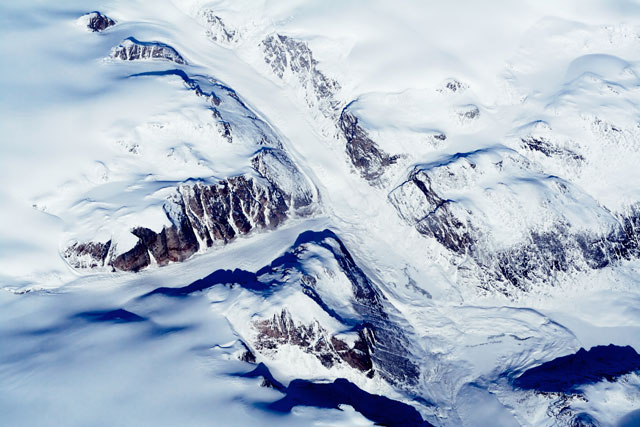
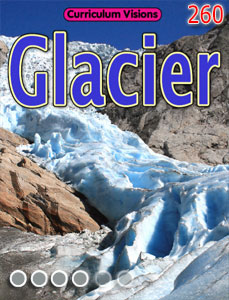
What is a glacier? A glacier is a tongue of ice, which flows entirely within a valley. If a glacier comes out of mountains and spreads out onto a plain it becomes part of an ice sheet. If valley glaciers fill their valleys during an ice age, the ice spills over the crests to make a mountain ice cap, or if larger, a mountain ice sheet.
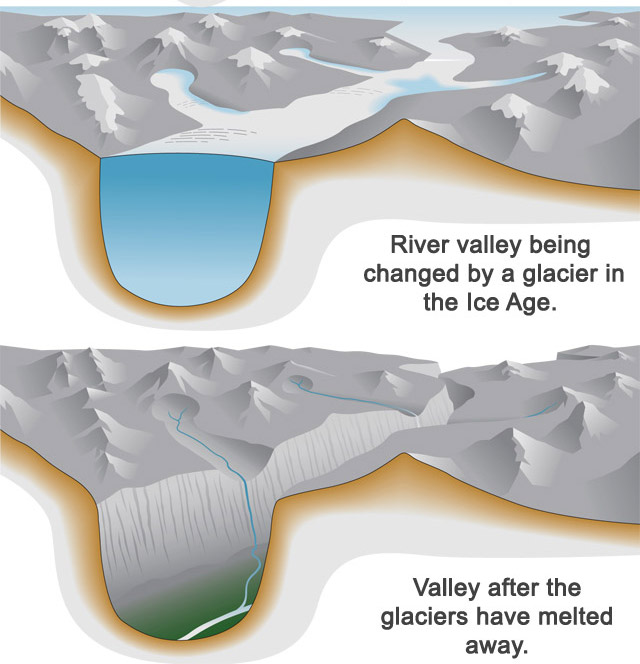
A river valley can be changed greatly when a glacier flows through it.
HOW A GLACIER FORMS
High mountains are cold. In some places, the snow that falls in winter does not all melt during summer. More snow falls on top of it year after year.
The weight of the new snow squeezes the older snow underneath. The snow crystals are crushed and packed together until they become solid ice. When enough ice has built up, its great weight makes it begin to move downhill. A glacier has formed.
A glacier may look still, but it flows very slowly downhill under its own weight. In a mountain valley it forms a long tongue of ice, rather like a very slow river.
Small glaciers can join larger ones, just as streams join a river. During an Ice Age, glaciers can fill whole mountain valleys. If the ice spreads over a much wider area, it becomes an ice sheet.
Moving ice is very powerful. Pieces of rock can become frozen into the bottom of a glacier. As the glacier moves, it pulls some rock away and drags other pieces across the valley floor.
The trapped stones scrape the rock rather like rough sandpaper. They grind some of it into very fine material called rock flour. This wearing away is called erosion.
Over thousands of years, this slow movement of ice can completely change the shape of a mountain landscape.
A glacier often begins in a hollow high on a mountainside. As the ice moves, it makes the hollow wider and deeper. The bowl-shaped hollow is called a corrie.
If glaciers cut backwards into opposite sides of a ridge, they can leave a very narrow, sharp ridge between them. This is called an arête.
Where several glaciers wear into a mountain from different sides, they may leave a sharp pointed peak. Ice and frost therefore help to give high mountains their jagged shapes.
Before a glacier arrives, a mountain river may have cut a narrow V-shaped valley. A glacier is much wider and fills far more of the valley.
As the ice moves, it wears away the valley floor and sides. The valley becomes wider, deeper and straighter, with steep sides and a broad floor. Seen from the end, it looks rather like the letter U, so it is called a U-shaped valley.
When the climate becomes warmer and the glacier melts, the great valley remains. A much smaller river may then flow along its floor.
The broad, straight shape of a valley that has been formed by a glacier.
A large glacier in a main valley can cut down more deeply than a smaller glacier in a side valley.
When the ice melts, the smaller valley is left high above the floor of the main valley. It seems to hang on the mountainside, so it is called a hanging valley.
A stream flowing along it may plunge over the edge into the main valley. This is why waterfalls are common in mountain landscapes that were once filled with glaciers.
A glacier does not wear every part of a valley at the same speed. It can scoop some places more deeply, especially where the rock is weaker.
After the glacier melts, water may fill these deeper hollows and make long, narrow ribbon lakes.
Ice can also spill from one valley into another and wear down a route across a ridge. When the ice has gone, this may leave a pass. Passes are useful because they provide easier routes through high mountains.
A glacier carries stones, sand and fine rock as it moves. When the ice melts, this material is dropped. Piles and ridges of material left by a glacier are called moraine.
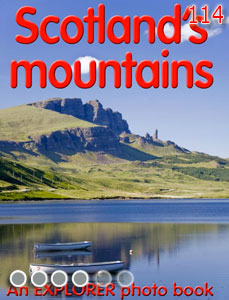
Most glaciers that shaped Britain's mountains disappeared thousands of years ago. But their work is still easy to see. Corries, arêtes, U-shaped valleys, hanging valleys, waterfalls, ribbon lakes and moraine are clues that tell us where the ice once flowed.
The toolkit screen link will take you to a library containing a selection of:
an i-topic, more books, pictures, videos and teacher's stuff related to the search word.