Explore these further resources...
(These links take you to other parts of our web site, never to outside locations.)
You can search in this book:



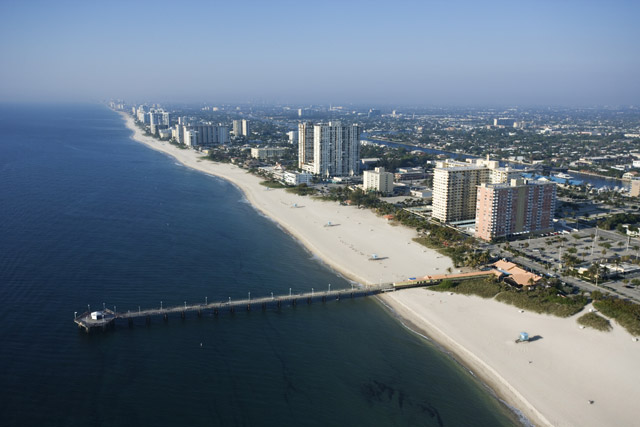
The coast of Florida, America.
The coast is always changing. Waves hit the land, tides move water in and out, and rivers bring mud and sand to the sea. Wind can also move dry sand along beaches and into dunes.
Some coasts have steep cliffs. Others are low and flat with wide beaches. The shape depends on the rocks, the strength of the waves and how much sand or shingle is available.
↑ ContentsNot all rock is equally strong. Where stronger rock reaches the sea, it may be worn away more slowly and stick out as a headland. Weaker rock may be worn away faster and form a bay.
Bays are often more sheltered from strong waves, so beaches may build up there. Headlands face the full force of the sea and may have steep cliffs.
↑ ContentsWaves can strike cliffs with great force. They push water and air into cracks and may loosen pieces of rock. Pebbles and sand carried by the waves can also scrape against the cliff.
Over time the foot of the cliff may be cut back. The rock above is left sticking out and can collapse. The fallen pieces are then broken into smaller and smaller fragments.
This wearing away of the coast is called erosion.
↑ ContentsOn a headland, waves may find a crack in the rock and widen it into a cave. If erosion continues, the cave may cut right through the headland to form an arch.
The roof of an arch can eventually collapse. This may leave a tall pillar of rock standing by itself in the sea. It is called a stack.
These features show how a coastline can change step by step over a long time.
↑ ContentsBeaches are made from sand, shingle or a mixture of both. Some beach material comes from cliffs, and some is brought by rivers or moved from another part of the coast.
Waves often arrive at the beach at an angle. They push material up the beach at that angle, while gravity pulls it back down more directly. Repeated again and again, this moves sand and pebbles along the shore. This movement is called longshore drift.
Beaches are important because they can absorb much of a wave's energy before it reaches cliffs or sea walls.
↑ ContentsWhen moving water slows down, it may drop the sand and shingle it is carrying. This is called deposition.
Longshore drift can carry sand past a bend in the coastline and build a long narrow ridge out into the sea. This is called a spit.
On dry beaches, wind can blow sand inland. Plants trap some of the sand and help build sand dunes. Dunes can become important habitats and can also help protect the land behind them from storms.
↑ ContentsAn estuary is the wide tidal mouth of a river where fresh water mixes with sea water. Estuaries are often sheltered and can provide good places for ports, mudflats and wildlife.
Some coasts have long narrow inlets. In Scotland, sea inlets are often called sea lochs. A fjord is a very deep, steep-sided inlet made where a glacier once cut a valley and the sea later flooded it.
These features show that coasts can be shaped both by the sea and by things that happened on the land long ago.
↑ ContentsPeople live and work at the coast for many reasons. Fishing, ports, boat building, tourism and seaside resorts all depend on the coast in different ways.
Coastal towns may also attract people because of beaches and views. But living close to the sea can bring problems. Storm waves, flooding and cliff erosion can damage homes, roads and other buildings.
Coasts are also important habitats. Cliffs, dunes, salt marshes, mudflats and rocky shores provide homes for many plants and animals.
↑ ContentsPeople sometimes build sea walls to protect towns from waves. Large rocks can be placed at the foot of cliffs, and wooden or stone barriers called groynes can trap sand moving along a beach.
But protecting one place can change what happens farther along the coast. For example, a groyne that traps sand may leave less sand to reach the next beach.
Sometimes the best choice is not to build a new defence, especially where few people or buildings are at risk. In some places the coast is allowed to change naturally.
↑ ContentsVideo: Coast introduction.
Video: Coastal sand dunes.
Video: Sand spits.
Video: Coastal homes.
Video: Groynes and beach protection.