
|
Length: 4400 kilometres (2700 miles); drainage basin 1.9mill square kilometres (720,000 square miles). The Amur is one of Asia's longest rivers. The Amur proper (after the confluence of the Shilka and Argun rivers) is 2800 kilometres (1800 miles) long. Tributaries include: Zeya, Bureya, Sungari, Ussuri, and Amgun
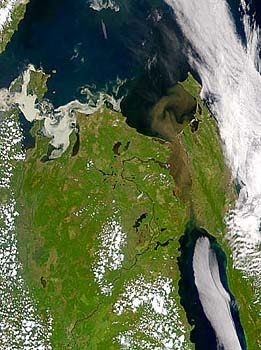
The River Amur.
The Amur basin receives a monsoon climate, with high rainfall in summer and a long dry winter. The winter floods in the summer and the land near the lower part of the river course turns into a huge lake. The source of the Amur is on the borders of Russian Siberia, Mongolia and China. The first part of the course is eastward, where it forms the Russia/China border. At Khabarovsk, Siberia the river turns northeastward, eventually flowing into the Pacific Ocean near the Sea of Japan. The upper part of the river flows in the edge of the Central Asian mountains, flowing through deep gorges and then flowing into wide plains between mountain ranges. By contrast, when the river leaves the mountains and flows toward the ocean, it flows over a low flat land that produces vast marshes. The Amur is navigable for 2800 kilometres (1700 miles) from its mouth for about 6 months after the start of the monsoon. |
