


Page 52 - Curriculum Visions Dynamic Book
P. 52
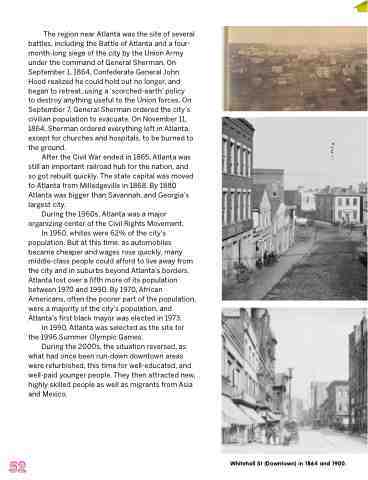
The region near Atlanta was the site of several battles, including the Battle of Atlanta and a four- month-long siege of the city by the Union Army under the command of General Sherman. On September 1, 1864, Confederate General John Hood realized he could hold out no longer, and began to retreat, using a ‘scorched-earth’ policy
to destroy anything useful to the Union forces. On September 7, General Sherman ordered the city’s civilian population to evacuate. On November 11, 1864, Sherman ordered everything left in Atlanta, except for churches and hospitals, to be burned to the ground.
After the Civil War ended in 1865, Atlanta was still an important railroad hub for the nation, and so got rebuilt quickly. The state capital was moved to Atlanta from Milledgeville in 1868. By 1880 Atlanta was bigger than Savannah, and Georgia’s largest city.
During the 1960s, Atlanta was a major organizing center of the Civil Rights Movement.
In 1960, whites were 62% of the city’s population. But at this time, as automobiles became cheaper and wages rose quickly, many middle-class people could afford to live away from the city and in suburbs beyond Atlanta’s borders. Atlanta lost over a fifth more of its population between 1970 and 1990. By 1970, African Americans, often the poorer part of the population, were a majority of the city’s population, and Atlanta’s first black mayor was elected in 1973.
In 1990, Atlanta was selected as the site for the 1996 Summer Olympic Games.
During the 2000s, the situation reversed, as what had once been run-down downtown areas were refurbished, this time for well-educated, and well-paid younger people. They then attracted new, highly skilled people as well as migrants from Asia and Mexico.
52
Whitehall St (Downtown) in 1864 and 1900.


