


Page 36 - Curriculum Visions Dynamic Book
P. 36
36
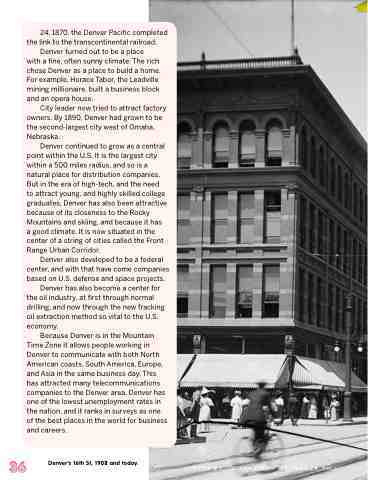
Denver’s 16th St, 1908 and today.
24, 1870, the Denver Pacific completed the link to the transcontinental railroad.
Denver turned out to be a place
with a fine, often sunny climate. The rich chose Denver as a place to build a home. For example, Horace Tabor, the Leadville mining millionaire, built a business block and an opera house.
City leader now tried to attract factory owners. By 1890, Denver had grown to be the second-largest city west of Omaha, Nebraska.
Denver continued to grow as a central point within the U.S. It is the largest city within a 500 miles radius, and so is a natural place for distribution companies. But in the era of high-tech, and the need to attract young, and highly skilled college graduates, Denver has also been attractive because of its closeness to the Rocky Mountains and skiing, and because it has a good climate. It is now situated in the center of a string of cities called the Front Range Urban Corridor.
Denver also developed to be a federal center, and with that have come companies based on U.S. defense and space projects.
Denver has also become a center for the oil industry, at first through normal drilling, and now through the new fracking oil extraction method so vital to the U.S. economy.
Because Denver is in the Mountain Time Zone it allows people working in Denver to communicate with both North American coasts, South America, Europe, and Asia in the same business day. This has attracted many telecommunications companies to the Denver area. Denver has one of the lowest unemployment rates in the nation, and it ranks in surveys as one of the best places in the world for business and careers.


