


Page 248 - Curriculum Visions Dynamic Book
P. 248
248
district as “The Territory of Columbia,” and the federal city as the “City of Washington.”
The city survey team laid out a square containing the full 100 square miles (260 km2) that the government had authorized. The survey team placed sandstone boundary markers at or near every mile point along the sides of the square. Many of these markers still remain.
In 1791, President Washington appointed Pierre
(Peter) Charles L’Enfant to make a plan for the new city. L’Enfant’s plan was a grid centered on the United States Capitol, which would stand at the top of a hill (Jenkins Hill). North-south and east-west streets formed the grid. Wider diagonal “grand avenues” (which were later named after the states of the union) crossed the grid. Where these “grand avenues” crossed each other, L’Enfant placed open spaces in circles and plazas that were later named after notable Americans.
L’Enfant’s broadest “grand avenue” is now the National Mall, while Pennsylvania Avenue connected the “Congress house” (the Capitol) with the “President’s house” (the White House). However, the plan needed amendments, something that L’Enfant was not keen on, so it was left to Ellicott to finish the plan, and it is that one we see today.
In 1801 the Federal District come under the control of Congress. The capitol was begun, and the Congress settled in. However, in 1812 there was a further conflict with Britain, and during this British ships sailed up the Potomac and burned part of the city, including the Presidential Mansion (the White House), the United States Capitol, the Arsenal, the Navy Yard, the Treasury Building, and the War Office
After the war, rebuilding began. But in the following years there was a problem with the slave trade. Alexandria was a center for slave trading and it was fearful its business would be damaged if there was an end to slavery.
Washington remained a small city of a few thousand residents, virtually deserted during the summertime, until the outbreak of the Civil War in 1861. President Abraham Lincoln created the Army of the Potomac to defend the federal capital, and thousands of soldiers came to the area.
Slavery was abolished throughout the District in 1862.
By 1870, the District’s population had grown to nearly 132,000 residents but, like most other cities, Washington still had dirt roads and had no sanitation. From 1873 there
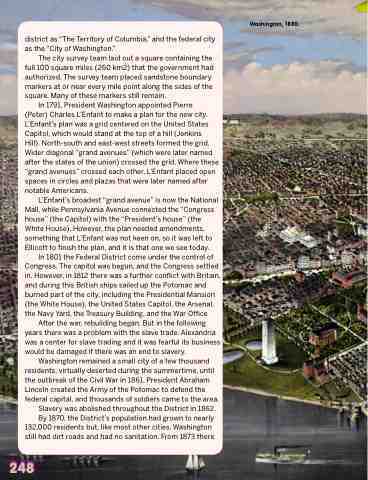
Washington, 1880.


