


Page 238 - Curriculum Visions Dynamic Book
P. 238
Wisconsin
Madison, the capital city of Wisconsin
Founded (1829) 1839 Incorporated (village) 1846 Incorporated (city) 1856
Doty’s idea to have a city on the strip of land between Lakes Mendota and Monona. At the time he purchased the land, in 1829, it was forest and swamp between a string of lakes on the Yahara River, one of the headwater branches of the Mississippi.
In 1836 the Wisconsin Territory was created. The government met for the first time in Belmont, and one of its tasks was to select a permanent site for a capital city. Doty was not slow to push for his site to become his city, offering all kinds of incentives, such as cheap prime lots, for the legislators. He also name the proposed city (it had not even been begun) Madison, after the president who had died that year. He named other streets for the other 39 signers of the U.S. Constitution. If Doty could get the prize of the capital, his site would be worth a fortune.
As it happened, the site he was calling Madison was about midway between the growing city of Milwaukee and the old trading post of Prairie du Chien , the lead mining regions to the south, and Green Bay in the north, which was the territory’s oldest city.
Elevation
Population
Metro
Madison is the second largest city in
873 ft (226 m) 233,209
627,431 (US: 85th)
Wisconsin, after Milwaukee. Contents [hide]
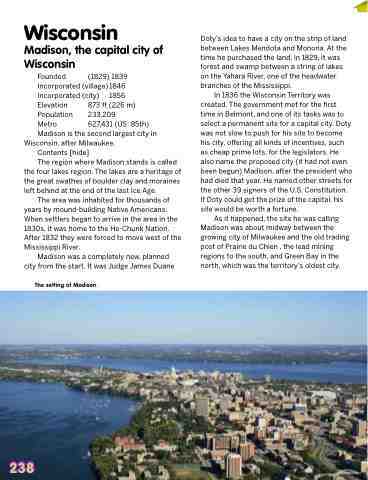
The region where Madison stands is called the four lakes region. The lakes are a heritage of the great swathes of boulder clay and moraines left behind at the end of the last Ice Age.
The area was inhabited for thousands of years by mound-building Native Americans. When settlers began to arrive in the area in the 1830s, it was home to the Ho-Chunk Nation. After 1832 they were forced to move west of the Mississippi River.
Madison was a completely new, planned city from the start. It was Judge James Duane
The setting of Madison.
238


