


Page 230 - Curriculum Visions Dynamic Book
P. 230
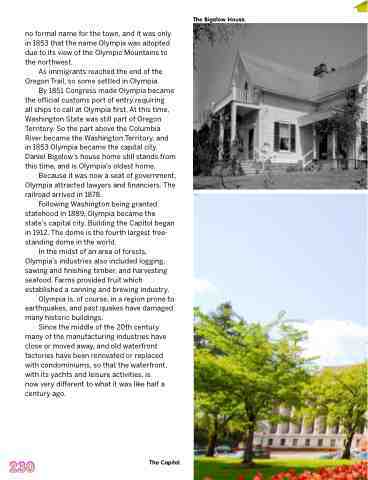
The Bigelow House.
no formal name for the town, and it was only in 1853 that the name Olympia was adopted due to its view of the Olympic Mountains to the northwest.
As immigrants reached the end of the Oregon Trail, so some settled in Olympia.
By 1851 Congress made Olympia became the official customs port of entry requiring
all ships to call at Olympia first. At this time, Washington State was still part of Oregon Territory. So the part above the Columbia River became the Washington Territory, and in 1853 Olympia became the capital city. Daniel Bigelow’s house home still stands from this time, and is Olympia’s oldest home.
Because it was now a seat of government, Olympia attracted lawyers and financiers. The railroad arrived in 1878.
Following Washington being granted statehood in 1889, Olympia became the state’s capital city. Building the Capitol began in 1912. The dome is the fourth largest free- standing dome in the world.
In the midst of an area of forests, Olympia’s industries also included logging, sawing and finishing timber, and harvesting seafood. Farms provided fruit which established a canning and brewing industry.
Olympia is, of course, in a region prone to earthquakes, and past quakes have damaged many historic buildings.
Since the middle of the 20th century many of the manufacturing industries have close or moved away, and old waterfront factories have been renovated or replaced with condominiums, so that the waterfront, with its yachts and leisure activities, is
now very different to what it was like half a century ago.
230
The Capitol.


