


Page 174 - Curriculum Visions Dynamic Book
P. 174
Pennsylvania
Harrisburg, the capital city of Pennsylvania
Founded 1719 Incorporated 1791
Charter 1860
Elevation 320 ft (98 m) Population 49,528
Metro 560,849 (95th)
Harrisburg lies on the east bank of the Susquehanna River. To the north is the Blue Mountain ridge of the Appalachian Mountains.
For thousands of years before the arrival of Europeans, the site that would become Harrisburg was the home to Native Americans. When Englishman, Captain John Smith, arrived from Virginia up the Susquehanna River in 1608 he visited the Susquehanna tribe. He did not form ant kind of settlement. That was left to 1719, when John Harris, who was an English trader.
Harris chose a place for his trading post which turned out to be important to Westward expansion after the American Revolutionary War. It was just east of a pass in a ridge of the Appalachian Mountains. The Susquehanna River was navigable from the sea to Harrisburg, but the Fall Line, the line separating the coastal and upland parts of the river, was just upriver from Harrisburg. This meant that boats could go no farther and any goods being transported had to be taken off and carried overland. In 1785, his son, John Harris, Jr. planned a town on his father’s land. He named it Harrisburg.
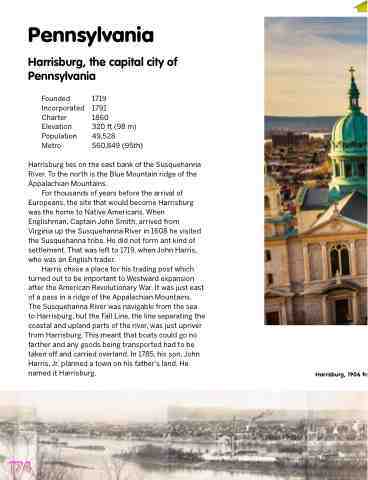
Harrisburg, 1906 fr
174
o


