


Page 116 - Curriculum Visions Dynamic Book
P. 116
116
The capital was renamed for General Andrew Jackson, to honor his victory in the Battle of New Orleans during the War of 1812.
The plan for Jackson began in 1822, with city blocks mixed with parks and other open spaces. However, this original plan for a free and spacious city was not kept to, and most of the planned open spaces have now been built over.
The railroad came to Jackson in 1840. But as Jackson was not on the Mississippi it did not develop into a trading center.
During the civil war, Jackson was a strategic prize for both sides. When the
Union forces finally captured it, what was left was a burned over ruin. The city was called “Chimneyville” because only the chimneys
of houses were left standing. As a result
of the destruction, many of the fine pre-
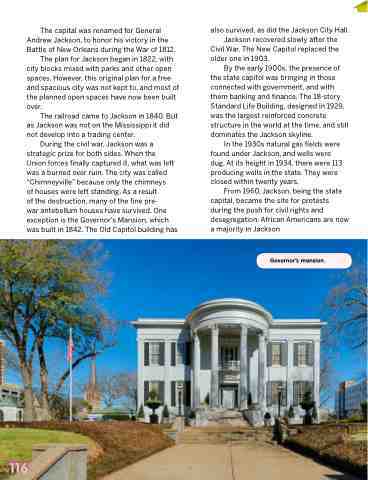
war antebellum houses have survived. One exception is the Governor’s Mansion, which was built in 1842. The Old Capitol building has
also survived, as did the Jackson City Hall. Jackson recovered slowly after the
Civil War. The New Capitol replaced the older one in 1903.
By the early 1900s, the presence of the state capitol was bringing in those connected with government, and with them banking and finance. The 18-story Standard Life Building, designed in 1929, was the largest reinforced concrete structure in the world at the time, and still dominates the Jackson skyline.
In the 1930s natural gas fields were found under Jackson, and wells were dug. At its height in 1934, there were 113 producing wells in the state. They were closed within twenty years.
From 1960, Jackson, being the state capital, became the site for protests during the push for civil rights and desegregation. African Americans are now a majority in Jackson
Governor’s mansion.


