


Page 43 - Curriculum Visions Dynamic Book. To close the book, close the tab.
P. 43
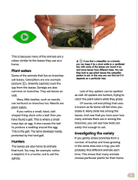
This is because many of the animals are a colour similar to the leaves they use as a home.
Plant eaters
Some of the animals that live on branches eat leaves. Caterpillars are one example (picture ). Greenfly (aphids) suck the sap from the leaves. Earwigs are also common on branches. They eat leaves as well.
Many little beetles, such as weevils, can be found on branches too. Weevils are plant eaters.
If you notice a small, black, ball- shaped thing stuck onto a leaf, then you have found a gall. This is where a small wasp lays an egg. It also causes the leaf to produce a swelling around the egg. This is the gall. The larva develops inside, protected by the hard gall.
Hunters
The leaves are also home to animals that hunt. You may, for example, notice a ladybird. It is a hunter, out to eat the aphids.
If you find a caterpillar on a branch,
you can keep it for a short while in a ventilated box with some of the leaves you found it on, and some leaves from different trees. You can then look to see which leaves the caterpillar prefers to eat. In this way you can find out if it depends on a particular tree.
Lots of tiny spiders can be spotted as well. All spiders are hunters, trying to catch the plant eaters while they graze.
Of course, not everything that uses a branch as its home will fall when you shake it. Many birds live among the leaves. And now that you have seen how many animals there are in among the branches, you can see how birds can easily find enough to eat.
Investigating the variety
If you gently shake branches from a number of bushes and trees growing
in the same area over a tray, you will probably find different animals each time. This shows that many animals choose particular plants for their home.
43


